Showing posts with label Beatle Book Monthly. Show all posts

Wednesday, February 11, 2026

The Beatles in Paris (BBM 1964)


 The Beatles in Paris

By "Billy Shepard"

Beatle Book Monthly

March 1964


    Paris fell! Collapsed! Capitulated! Waved the white flag of surrender after only a few blasts of opening fire --fire that sounded very much like "She Loves You."The Fabulous International Beatles had struck again and infected a whole country with Beatlemania. 

    They took little time to settle in, but I was there to watch the excitement grow and grow among the fanatical French fans, until the Beatles finally left Paris after three weeks to a riot of hysteria. But was pretty chaotic early on. In fact, they nearly didn't even make it on time -Tuesday, January 14.  Ringo Starr was unable to meet the others in London, having been fog-bound in Liverpool. "I'll make my own way. See you all in Paris," he wired. And at London's airport, thick mist swirled around the buildings and the planes. "We've had it too," said Paul, looking anxiously at the sky, but the misty fog lifted-- lifted just enough to get planes in and out of the airport. 


    One plane, Comet 4B was extra special. It had three-quarters of the Beatles aboard, John, Paul, George, plus Brian Epstein and Mal Evans, press representative Brian Summerville, sundry others, me, and a load of photographers and reporters. The Beatles posed for a few pictures, waved to the fans who yelled "Good luck", and ran up the stairs and to the front of the of the plane. 

    A few minutes later, Captain A.J. Holderness eased the massive aircraft off the strip at 5:15pm.  35 minutes later, we coasted into Le Bourget Airport, a few miles outside Paris, and coasted into a mad rush that threatened to engulf the Beatles. Yelling, photographers, questioning reporters, gabbling in French, flashlights exploding all the way through the customs with The Beatles trying to maintain a trio of resolute grins. 

    Fans scream. Quite a solid batch of them, including eight-year-old Anne Maskell of Tooting, South London, on her way through to Austria with her parents. "It is the Beatles! It is!" She yelled excitedly. Paul flashed her a quick smile. 

    The boys were half-frog-marched through customs. Officials had time only to glance at the preferred passports. Then the Beatles were hidden in a mass of newspapermen-- and me -- into the car, the Beatles' Austin Princess driven by chauffeur Bill. More flashlights pop and often to the heart of Paris, to the fabulous, lush George V Hotel close to the Champs Élysées, a maze of people waiting. The swing doors revolve fast, pushed by a head doorman wearing a "chain of office."

     Inside, more pandemonium, everybody craning to get a look at the Liverpool lads. Voices of English fans rise above the French fast talk. More flash bulbs erupt. The management of this dignified, superfab hotel looked disturbed.

     Eventually, the Beatles get through to the comparative peace and quiet of their suites. John eyes the tapestries,  and the Louis Fourteenth furniture says, "Looks something like a museum." The others laugh. They laugh easily. For a moment, the tension is over. 

    There should have been a rehearsal that evening, but without Ringo, there was no point. Said George, "It's odd. Without Ringo, we sort of feel we've lost a limb." The "limb" was in Liverpool, making final preparations to catch a plane to London, and then straight across the following day, 

    John and Paul took that first night easily, just relaxed in their suite, calling for ciggies and for Cokes. George wandered off with a newspaperman, ending up in the expensive Eve club, watching a high-charged (in both ways) cabaret. "It's a smart place," said George, "but the music was pretty standard-- sort of swing. Nice as background to a chat, though."

      John and Paul thought back to the time they'd been in Paris before, flat broke, unable to afford a taxi without funds for a decent meal. "Maybe we'll buy the Eiffel Tower this time," said John with a grin. The boys made friends easily. Bruno Coquatrix, guv'nor of the Olympia, called round to see his latest signings, and a representative of Odeon Records, who released the boys' disc throughout France.

     When the room was finally cleared and with George still out on the town, the McCartney-Lennon partnership talked songs. Recording manager George Martin was coming to Paris and wanted to hear some brand new material. John and Paul were committed to writing six songs for the upcoming film, one for Billy J Kramer and one for Tommy Quickly, and they hoped to get the next single from that half dozen for the movie. Time was against them. "We'll get a piano moved into the suites," said Paul, "that'll help speed things up." Normally, the boys just worked with guitars.

     Those suites were fantastic. John and Paul shared because they had to cope with their songwriting chores. George and Ringo were together, though all four had communicating doors and were on the same landing. It was as though the Beatles entourage had taken over the bulk of the hotel.

     Top stars of all walks of life stay at the George V Hotel. For the first few days, film star Burt Lancaster was there, and yes, he had heard of The Beatles, and he only wished that there were more time available to meet them and get to know more about the British music scene. 


    On Wednesday morning, the Beatles were late getting out of bed. Nothing unusual! In a sense, they are night people, rarely properly waking up during the daytime. Brekkie was arranged, not the standard French one of rolls, butter, and coffee. They went for orange juice, corn flakes, pot of tea, a little cooked up mixture of scrambled egg and accessories. Said George, "I think we're gonna like Paris. I only hope the French people like us." They did. 

    The boys delayed showing themselves. They said they'd be up at 12 noon, and it was around three o'clock in the afternoon when they finally made an appearance out along the Champs Élysées, with photographers following their every move, cries of "It's the Beatles!" in German, French, and English, followed the boys. There were traffic jams. Scots teenager Inez Ufington was heard to say, " It's marvelous! I've not seen the boys before, now I feel weak at the knees..."


    The crowds grew great, but before they got out of hand, the Beatles were driven back to the Hotel George V to wait for Ringo. He arrived at Le Bourget at five o'clock, was picked up by a British car entering at the Monte Carlo Rally, driven by Stuart Turner, and rushed to join the rest at the hotel. Lucky he did, too, because the Austin Princess broke down coming back from the airport. Brian Summerville, along with the Beatles Monthly Book photographer, transferred to a taxi and left the Princess to be repaired.

     Many fans from Liverpool had heard that Ringo was driving all the way to Paris in one of the competition cars, and they flooded the switchboards, wondering about his route. They also flooded the switchboard at the George V Hotel. "Please, please. Let me talk to a Beatle!" came the calls, "We want to wish them luck."

     All four Beatles eventually made their way to the Cyrano Theater in Versailles, some 10 miles from the center of Paris. This was tryout night. The show started at nine o'clock and went until well after midnight. The boys went the proverbial bomb, numbers like "Roll Over Beethoven," "This Boy," "She Loves You." The latter, the audience knew well. The Beatles had a highly rated disc on this in France.


     A young audience. Gendarmes held them back as they tried to swarm backstage. Fans danced in the aisles and chanted "Les Beatles." One aged about 17, dressed in a red sweater, shimmied his way to the front of the stalls, rocking in time with the solid Beatles beat. He couldn't restrain himself any longer. He jumped up on the stage and started trying to do a dance routine with John Lennon. John went on blasting away at a set of lyrics, but couldn't help a quick grin. And on came the massive Mal Evans, road manager number two, to clutch the offender in his mighty arms and card him off into the wings.

    But it was noticeable that the audience actually let the Beatles be heard. You could pick up the words of songs, and there were more boys than girls in the audience, but everybody joined in the clapping during songs. One girl cried out in plaintive French, "I just can't anymore My hands are hurting me!"

     A riot-- in fact, something not exactly expected in the rather staid center of Versailles. The boys made a hectic getaway just in front of a mob of fans, and Ringo barely had time to observe, "The audience was so different from those in England; they don't seem to squeal. It's more that the boys set up a roar-- marvelous, and I think they liked us." They did.

Photo taken by Paul McCartney


     But the newspapers, the following morning, contented themselves with stories about how the Beatles had looked around Paris. They were surprised at John's garb, dark glasses, a leather hat in a somber black from Mary Quaint, and an alligator-type coat. Their every move was reported. This side of the trip was stressful at the time because the big testing period was still ahead. The grand gala opening at the Olympia Paris on Thursday evening.

     The Beatles had another huge surprise yet to come, though. They made their way back by fast car to the George V Hotel and up to the suite. Two of the boys took a quick bath in the marble-walled bathrooms. Then they sat talking, and the news arrived direct from London. Came this message: the boys are at the top of the American hit parade. 

Photo taken by Ringo Starr

    "The boys went mad," said Mal Evans, who happened to come into the suite immediately afterwards. "They always act this way when anything big happens, just like a bunch of kids jumping up and down with sheer delight. Paul climbed onto my back, demanding a piggyback. They felt that this was the biggest thing that had ever happened, and who could blame them? Gradually, they quieted down, ordered some more drinks, specifically Cokes, and sat down to appreciate fully what happened. It was a wonderful, marvelous night for all of them. I was knocked out."

     Celebrations went on until five o'clock in the morning. Somebody else rang through to say it was the fastest rising disc ever by any British artist in the States.  That Capitol Records had never known anything like it -- three weeks to hit the top spot, British or American! 

    The boys had plenty to talk about-- about their own trip to America, about the thrill of audience reaction that night in Versailles, and on to the next morning  (Morning for The Beatles starts sometimes after two o'clock in the afternoon) Olympia, the top music hall in France, where every season starts with a stuffed shirt audience on the opening evening, where minks and diamonds fill every other seat and where dinner jackets fill the rest.

     A small fronted theater, it looks singularly unprepossessing from the front, but once inside, it's beautifully decorated. Inside is a little bar with pictures decorating it of old variety acts, some of them were British. Modern, yes, but literally breathing the atmosphere of past show business idols who topped the Olympia bill. 

    The Stage Door is on a little side street. The Beatles arrived in the Princess, leapt out and hustled to the dressing rooms, a tiny room for the four boys with barely room to swing a guitar. At their hotel, they'd been used to a bigger bathroom each than the dressing room they had to share. 

    On the bill, Trini Lopez, also French songstress Sylvie Vartin, plus a full variety program, including the inevitable juggler. Trini closed the first half. Sylvie proceeded the bill topped the Beatles. Prices were high at 15 shillings minimum. 

    In the afternoon, the fans were in. They loved the boys. Later, sophisticated Parisians filled the seats. Again, the boys did well, despite three failures in amplification, with Malcolm Evans leaping onto repair the damage in an expensive theater, yet the electricity went wrong!


     No squealing, no screaming, but audiences, which clapped in time, appreciated every number. "Merci beaucoup," said Paul, the only French they attempted. The cameramen who were everywhere attempted slices of English. They mobbed the stage, firing off at every movement the Beatles made.

     But the real drama was going on backstage. Fists flew in that confined space. Malcolm Evans said "The trouble started when a French photographer was not allowed to take exclusive pictures." But there were other outbreaks of trouble. Paul called out for order. Nobody listened. George had to protect his guitar from swinging fists. The gendarmes arrived on the scene to try and sort things out. They only added to the chaos.

     On later evenings, the backstage area was declared "no man's land." The police positively refused to let anybody through. But the initial damage was done. In the rush of Beatlemania, many people who held genuine tickets were kept out of the theater. Some who did manage to get through found their seats had been taken and they had to watch the show from standing in the back of the stalls. Some of the audience left before the end, but that is standard practice in Paris. People want to avoid a crush. And outside stood crush barriers manned by truncheon-carrying policemen to curb the enthusiasm of the fans shouting, "Beatles. Beatles. Beatles!" outside.

    Brian Epstein, guiding light of the Beatles and George Martin were in the audience and heard the applause and the wave of enthusiasm. One felt sorry for Sylvie Varton, blonde and shapely, who had her act interrupted by the crowd's cries of " We want Les Beatles!" An ironic note was struck when part of the interval music at the theater was a gramophone record of the Shadows.

     The evening performance was an even bigger test for the boys. They did well. Though the French press were not particularly kind, the audience liked them, and so did the fans waiting outside the theater. French stars were there to cheer like Francois Hardy, Johnny Halliday, Richard Anthony, and Britain's Pet Clark. 

    The Beatles exit was hectic. A few more punches among photographers were slung, but the exit was made back to the hotel for a few hours kip before the papers came out. The press was frankly mixed. One (Parisian Libere) said it was "Daddy's rock and roll stuff, nothing very new."  Another (Aurora) suggested it was Trini Lopez who had triumphed. But one influential voice (France Sois) said, "The Beatles must have caused jealousy among the French pop idols, because never before had hands beaten in time so loudly at an Olympia opening."

    But the fans are the ones who matter, and the Beatles were besieged at their hotel by French boys and girls who wanted an autograph,  and by English girls who just wanted to speak to them. The disc shops made big displays of Beatles records. The posters on huge hoardings proclaimed their presence in Paris. Life for The Beatles went on from one rush to another. 

    The first Sunday, they had them doing three shows at the Olympia. They had to sleep. They had to keep dates with French photographers and journalists. Brian Summerville was the most harassed man in Paris.

     A typical day starts with sleeping until mid-afternoon, getting up and meeting important people, going to the theater and doing two shows, popping off and eating somewhere, getting back to the hotel, and talking about everything and anything until around five o'clock or even later.

     The critics had been unkind in the main. Some of the older folk had dismissed the Beatles with a curt "non," but the young fans were growing day by day. As the stay in Paris developed, the police had bigger and bigger crowds to deal with outside the theater. The boys became big idols, and not merely on the strength of a hit record. They were part of the bustling French scene.


     Whenever they could, they went out and viewed the sights. They took their £250 cameras with them and shot anything of interest. And still, the fans from England took time out and spared no expense in ringing the George V Hotel in the hope of getting a few words with the boys. 

    I watched the hysteria grow, and I felt proud of the boys. World interest in the Beatles had gone a stage further forward. By the end of the run, they were undisputed guv'nors of Paris. They'd captured all sections of the community. It was tough just watching them leading such hectic lives, I felt worn out.

     But the year was only just starting for The Beatles. They had before them America, and their first big film production; there were a million more photographs to pose for, 1000 interviews to give, and more vitally important shows to perform. They're great and wonderful ambassadors for Britain in any part of the world where pop music is important, which is most of the world, and yet it's only the beginning. It's a fantastic thought, isn't it?

Sunday, February 8, 2026

How Different From the Cavern Days (1964)


How Different From the Cavern Days

By Dorene Hannah

Beatle Book Monthly

March 1964


    I would like to tell you about the days before the Beatles were well-known. They had a small group of Liverpool fans who used to queue outside the Cavern from 8am until 12 noon for the lunch hour sessions. Most of them used to take days off school or college and tried to copy their mother's handwriting in a note for the teacher. On Sundays, queuing commenced from about 2pm until 7:30pm. As The Beatles became more popular, queuing went on all through Saturday night and all Sunday until 7:30pm. Ray McFall would bring a crate of milk down between four and five and sit in his car with the radio on for us to listen to the top ten. 

    We used to queue in the freezing cold and tell stories about the Beatles while wrapped in blankets and sipping hot coffee. Everyone knew everyone, and if girls came who had only just heard of The Beatles, well all us "scousers" made them welcome. While we were waiting for the Cavern to open, we would ask some girls to save our places, and we would go to the Kardoma Cafe (KD) and then for a stroll round town. And sometimes we would meet a Beatle and stop for a talk, then go back to the Cavern.

     It was gear in those days, but it was sheer agony when the lads went to Hamburg; everyone walked round with long faces. The Cavern looked lonely when we passed with no people queuing. Sometimes the lonely Beatle fans would meet at a lunchtime session to cheer themselves up by talking about the lads. It was nothing short of chaos when their welcome home performance was on at the Cavern; girls fainted, and there was hardly any screaming, and no one was hysterical. At least you could hear the Beatles singing and joking. Those were the days. Sometimes I wish we could relive them, but I suppose the Beatles wouldn't. Well, good luck in the future, lads.

Tuesday, October 7, 2025

Faces of Harrison


October 7, 1965 - These amazing photos of George Harrison were taken for Beatle Monthly 60 years ago. 

Sunday, October 6, 2024

Walking with Paul


 July 7, 1968 

Paul would typically have a group of girls walk with him from Cavendish Avenue to Abbey Road and back again.   Here, you will notice that someone gave Paul the most recent copy of Beatles Book Monthly to read during the walk.  

Tuesday, July 16, 2024

The fan club made it possible


The autographed page from the Beatles Monthly 

The lucky Beatles membership card 


You all know that I am obsessive about Beatles fan clubs. Now that I have written a book all about the Beatles' North American fan clubs, I would love to write one about the Beatles' fan clubs in Europe, Japan, Australia, and other countries around the world. So, this story is especially great to me. 

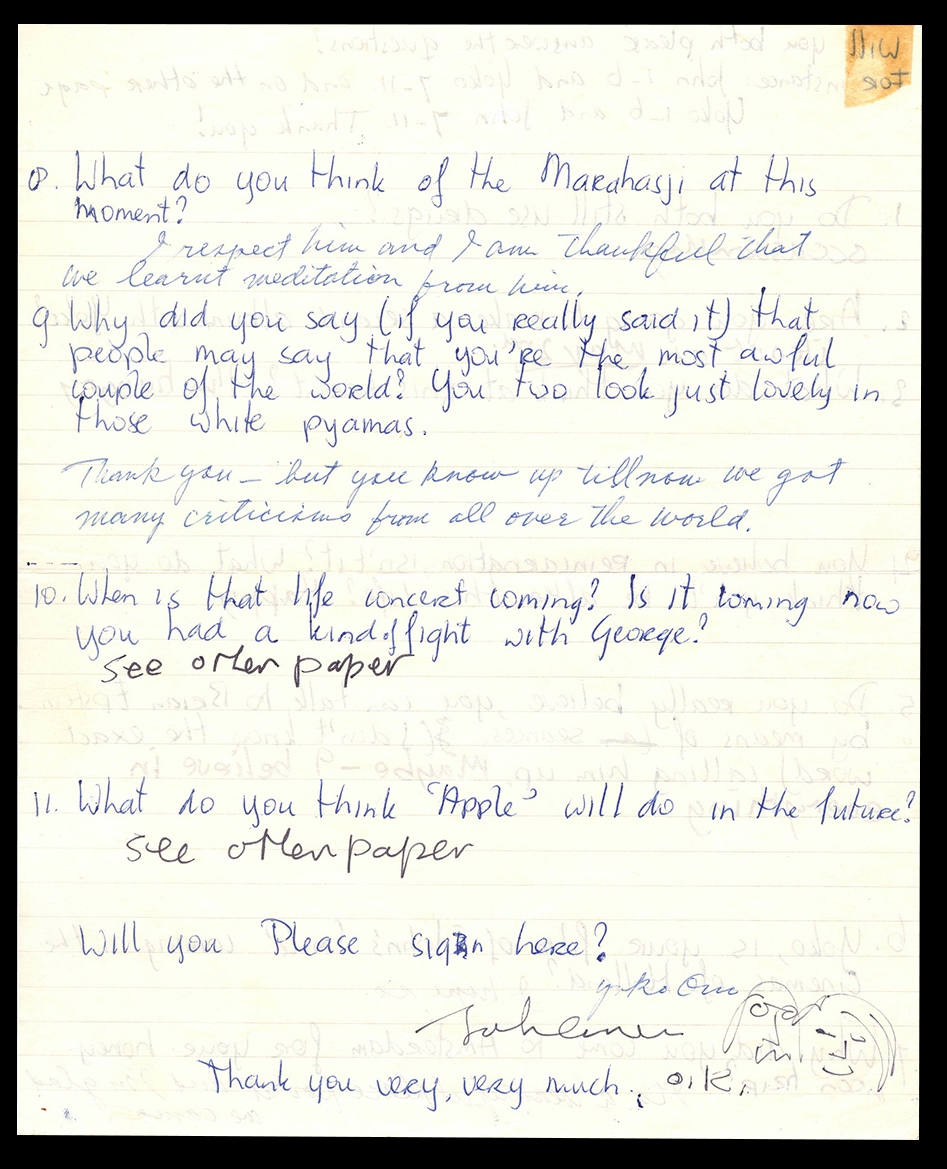
Last year, Gotta Have Rock n Roll auctioned items belonging to Constance Vrijdaghs, a Dutch Beatles Fan Club member.  She met John and Yoko during the Bed-In at the Amsterdam Hilton and had them autograph several items, asked them a few questions, and then left a questionnaire for them to fill out and return to her.   They completed the questions by hand and mailed it back to her.   She sold all of the items from that day.  

It is a great story. However, I found in the May/June 1999 Issue of Beatles Unlimited Magazine a reprint of her original story, which was published in the Fan Club newsletter Chains after she met them. The story is a tad bit different from her retelling over 50 years later, and she doesn't even mention the questionnaire.   I always find it interesting what someone writes about directly after the encounter.  Some of the things she wrote were big news at the moment, such as the Beatles having a new album and  a movie.  I hope you all enjoy this as much as I have. 


Written by Constance Vrijdaghs

Aerdenhout, Wednesday, 26th March, 1969,

It is almost impossible to believe, but this afternoon, I went to the Hilton and chatted with John and Yoko! Here's what happened to me! I arrived at the Hilton at about 5 PM and joined a boy and a girl that were watching John and Yoko's room. I asked them if they knew a way to get inside. I told them that I had my membership card from the fan club with me and that I had the intention of interviewing John and Yoko. The boy (Kees) asked if he could come along with me. After a lot of trouble, we were able to talk to a guy at the desk. I showed him my card and told him that I would like to interview John Lennon.

 I had to phone them. The phone was answered by a lady who told me that she had instructions to intercept any calls. The man at the desk took over the phone and transferred the call. A certain Mister Hille from Bovema the Beatles record company (pre-EMI) answered the phone and told me to wait 15 minutes, after which it would be possible to come upstairs. Indeed, two gentlemen came down, Mister Hille and Mister Boskamp. Again, I showed them my card. I just couldn't believe that I was taken up in an elevator and stood before the door before I realized it. Mister Boskamp opened the door, chatted a bit, and then told me that they were allowing me five minutes! 

We walked inside, where the couple sat on the bed in white pyjamas covered by white kimonos. I congratulated them on their marriage, thanked them for receiving us, asked for an autograph, and asked a couple of questions. They were married in Gibraltar, which was quiet and peaceful, and they had traveled to Amsterdam because it was a provocative city. They still thought that Provo was active! They spoke about Provo and their white bikes! At that moment they knew that they had been mistaken, because during that afternoon's press conference, they'd heard that Provo was gone now.   The next Beatles LP will be released this summer and John told me that there were plans to bring out another Beatles movie. Because I had with me the latest BEatles Monthly, something he hadn't seen yet, he read it and signed his autograph on it.  

Inside the room, there were lots of flowers and a large variety of fruit available.  After 15 minutes, we had to go. We quickly shook hands and left the room.  Great. I have never had so much respect for my membership card!


Tuesday, February 13, 2024

Thoese adorable Beatles


I don't think I have ever seen the complete version of this photo before.  I really like it.  

Sunday, December 19, 2021

White Album Q&A with Mal Evans


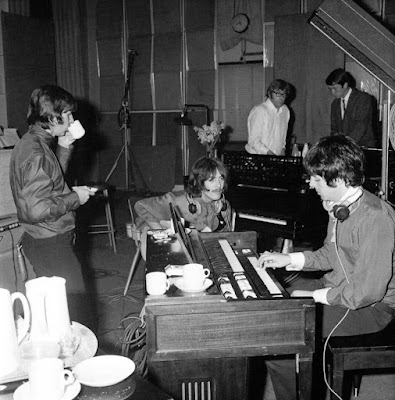
The Beatles Book Monthly is a gift that just keeps on giving.   After sharing what Mal had to say about the Get Back Sessions, I wondered what else, he, had to say about other sessions.   I found this Q&A with Mal from the February 1969 issue where he answers fans' questions about the newest Beatles album at that time, The Beatles.  


Your Album Queries

Answered by Mal Evans

Last month I told you I'd been ploughing through a huge mountain of mail from Beatles Monthly readers on the subject of the recent two-record album set.  Of course, many of you asked the same questions so I've been able to choose just 40 favourite queries from your letters for the WHO-WHAT-HOW piece which follows.


1.  Where was the photograph taken which shows Ringo (bearded) dancing with Elizabeth Taylor?

Answer:  During a party at London's Dorchester Hotel


2. Which Beatle put his lip prints on the album picture poster?

Answer:  The lip prints don't belong to any Beatle (Beatles just don't wear lipstick you know!!)


3.  Is the cat behind a cushion in one of the colour photographs Paul's Thisby?

Answer:  In a word -- No!


4.  On the poster with the album there's a big picture of someone lying back in a bath.  Is it John or Paul?

Answer:  Fellow with soap suds all around his head is Paul.

5.  There's one very old snapshot showing two boys in black leather gear  It looks as though it might be a picture of two Beatles taken in Hamburg days but the heads are cut off. 

Answer:  It is indeed an early Beatle pic but not taken in Hamburg.  That's Paul with John in Paris. 


6.  Who does the high "Beach Boys" voices behind Paul on Back in the U.S.S.R.?

Answer:  John and George together.


7.  Who plays the main guitar accompaniment behind John's voice on "Dear Prudence" and what sort of guitar was used?  

Answer:  John played his own backing here and used his Epiphone guitar.

8.  How was the violin-like effect achieved at the end of "Glass Onion?" 

Answer:  Would you believe -- with violins!

9.  Who played piano on "Ob-la-di Ob-la-da?"

Answer:  Pianist is Paul.

10.  Who says "Thank you" at the end of "Ob la di, Ob la da?"

Answer:  Thankful Beatle concerned is John.

11.  Who sings the line "Not when he looked so fierce" in a sort of childlike voice on "The Continuing Story of Bungalow Bill?"

Answer:  Wasn't one of the fellows at all, it was Yoko.

12.  Who plays guitar (the introduction and accompaniment) behind George's singing on "While my Guitar Gently Weeps?" 

Answer: Eddie Clayton -- but not the Liverpool Eddie Clayton (remember Ringo was once with the Eddie Clayton Skiffle Group on Merseyside around the first half of 1960 before he began drumming for Rory Storm's Hurricanes).

13. Does Paul play his own piano accompaniment for "Martha my Dear?"

Answer:  Yes he does.

14.  Which album track has Mal Evans playing a bit of trumpet?

Answer:  That's "Helter Skelter" which also has John playing saxophone!

15.  Who plays acoustic guitar behind Paul on "Blackbird?"

Answer:  Paul himself.  He recorded the accompaniment first and then did the vocal.

16.  How does George get that funny nasal effect on his voice midway through "Piggies"

Answer:  I don't want to get too technical about this so let me just say that his voice had to be filtered through special studio equipment to create that effect.

17.  How plays guitar accompaniment behind Paul on "Rocky Raccoon?"

Answer:  Again it's Paul himself and again the singing and playing were recorded at separate times.

18.  Who plays harmonica on "Rocky Racoon?"

Answer:  John

19.  Who plays that honky-tonk piano bit at the end of "Rocky Raccoon?"

Answer:  Our record producer George Martin

20.  Who plays Hammond organ on "Don't Pass me By?"

Answer:  Nobody plays an organ but the sound you mean comes from a specially prepared piano played by Ringo.

21.  What instruments are behind Paul on "I Will?"

Answer:  Normal Beatles line-up here with John on skulls!

22.  Who does the "2-3" count-in at the start of "Yer Blues"

Answer:  Ringo

23.  Did Paul write "Mother Nature's Son" while he was on his farm up in Scotland?  It sounds as though he was inspired by his surroundings.

Answer:  I know what you mean about the atmosphere of the words but John and Paul wrote this while they were in India about this time last year. 

24.  Details please of the backing on John's rocker "Everybody's Got Something to Hide Except for Me and My Monkey."

Answer:  No additional musicians here, just the usual Beatles line-up

25.  Whose idea was the extra ending for "Helter Skelter" and who sounds at the very end of it "I've got blisters on my fingers."

Answer:  THe extra ending was a joint idea really and none of the fellows can remember who suggested it.  The blistery voice belongs to Ringo.

26.  Is Ringo's drumming speeded up in some technical way at the end of "Long Long Long" or did he play as fast as that?

Answer:  He really played as fast as that!

27.  Does George Martin play piano on "Revolution 1"

Answer:  No.  It's Paul at the piano again.

28.  How did Paul make his voice sound like an old gramophone record for the words "Now she's hit the big time" in "Honey Pie?"

Answer:  Technical trick.  Highly secret!

29.  What brass instruments are there on "Savoy Truffle?"

Answer:  Two baritones and four tenors

30.  Whose voice says "Number Nine" at the opening of "Revolution No. 9?"  It sounds like John or Mal.  Is it the same voice later on?

Answer:  Yes, the same voice all through but it doesn't belong to me or John.  It was taken from an educational record from library stock.

31.  Before "Revolution No. 9" you hear a bit of conversation with someone saying to George, "I'd have brought some claret for you, George, but I forgot.  I'm sorry.  Will you forgive me?"  The voice didn't sound like Neil's or Mal's.

Answer:  That's because it wasn't Neil's or mine!  It was Alistair Taylor's voice.  Alistair is office manager of Apple.

32.  Did Geroge Martin do that beautifully warm orchestral arrangement for Ringo's "Goodnight?" 

Answer:  Yes he did.

33.  Did Paul make a mistake when he was recording the vocal of "Ob-la-di Ob-la-da?" towards the end Desmond stays home to do his pretty face instead of his wife, Molly, the band singer?

Answer:  No mistake.  Just a twist around of the verse which comes earlier on.

34.  Who plays an organ on "Cry Baby Cry?"

Answer:  Nobody.  It's a harmonium played by George Martin.

35.  Who plays the harpsichord (or is it a doctored piano) on "Piggies?"

Answer:  It is a harpsichord and the player is George Martin's assistant whose name is Chris Thomas.

36.  What are the extra instruments heard on "Dear Prudence?"

Answer:  Apart from the normal line-up of guitars and drums, you hear Paul on the piano and playing flugelhorn, John and I on tambourines, and a whole crowd of us including Jackie Lomax and Paul's cousin John lending pairs of hands for the clapping.

37.  Why did you release the album set in stereo first and not in mono until later?

Answer:  We didn't!  The fact is that for the first week or two at the end of November the factories just could not keep pace with the public's demand for copies of the album.  So in some places, you'd find a record shop had only stereo copies available because fewer people choose stereo and the really big demand is still for mono records. 

38.  Who plays what on "Long Long Long?"

Answer:  Other than the usual instrumentation we had George playing acoustic guitar and Paul on Hammond Organ.

39.  Is the chorus on "Goodnight" just the Beatles singing? It sounds like far more than four voices in the background.

Answer:  It is far more.  Eight in fact.  Four boys and four girls who were brought in to add the backing voices.

40.  Who was the first to make another recording of a song from "The Beatles" to put out as a single?

Answer:  We heard of several all at once.  Including the Marmalade doing "Ob la di, Ob la da", Cliff Bennett singing "Back in the U.S.S.R." and the Vic Lewis orchestra singings doing versions of "Goodnight" and "Julia."  

Monday, December 6, 2021

More of Mal's "Get Back" Memories


Mal's Diary

Beatles Book Monthly

Issue 68 (March 1969)

Written by Mal Evans


Going back, I will start on January 2, start of Twickenham fortnight. 


Kevin Harrington and I set up all the equipment in the huge bare Stage One at the film studios.  And they started filming us right there from the beginning.   There was no scenery or anything, just the standard white background with lots of different colour lights playing on it as the setting.  So that apart from capturing good sound there would b good things for the camera to see.

At half eight that morning, between bites of breakfast, I telephoned round all four fellows to remind them it was getting up time and they were due at Twickenham by eleven.  On that first day, Paul was last to arrive – half an hour after noon!  Having come by underground, then local train, then taxi from Hampton Court Station.  He’d meant to do the entire journey by public transport but, knowing he was late, he chickened out and caught a cab rather than wait at the bus stop.

During the weeks which followed he often used trains and buses to and from what amounted to routine hours five-day working week!

Toast, cornflakes and tea were ready for each arrival on the open space of Stage One every morning.  Beatles prefer to get where ever they’re going for the day and THEN start the day’s eating!

Kevin and I brought over all the food from the Studios canteen.  For lunch they started off by using some new flats which have been built for film actors and actresses so that they can make themselves at home between takes without leaving the studio area.  That didn’t work because the food was cold by the time we served it so we block-booked a couple of big tables in the canteen and added a bottle or two of good wine to whatever was on the day’s menu!  Of course, we all know that canteen well.  We’d worked there on “A Hard Day’s Night,” “Help!” and more recently on the “Hey Jude” TV film clips which were done on the same stage. So all the crews are old mates too.

During the first week at Twickenham it was Elvis’ birthday.  The following day at lunch I reminded everyone that Elvis had just turned 34.  Where upon John stood up and toasted Elvis and the rest of us joined in. 

One of the first new numbers the fellows got together was an up-tempo item of Paul’s called “Maxwell’s Silver Hammer.  If that title sounds familiar it’s because I mentioned it here in November as one of several numbers which were almost but not quite recorded before we finished “The Beatles” album sessions.  By the way, I play anvil on the finished version!

On Thursday, January 16, we finished at Twickenham and moved all our gear back into town.  On Monday January 20, we used the new Apple Studios in the West End for the first time.  Actually, Alex Mardas hadn’t put in our own studio equipment so EMI brought in an eight track tape machine and console as a temporary measure.  Alex started putting all the new equipment into the studio in the first week of February so that our most recent batch of sessions have made use of all his amazing gadgets!

The engineer for all these sessions at Apple has been Glyn Johns, a name you may well know for he’d got a great reputation and we were pleased we could get him.  He’s done a lot of stuff with The Stones at the Olympic Studios, produced the Steve Miller Band and so forth.  In fact, he’s more of a producer than an engineer although, of course, we had our own producer, recording manager George Martin on hand for that side of things.

First new number to be completed at Apple was something called “All I Want is You.”  Another was “Teddy Boy” and, as I mentioned earlier, there was “Maxwell’s Silver Hammer” from the end of last year. 

Although they’d had all the rehearsal time they needed at Twickenham and all their material was written and ready to be recorded, the fellows spent hours each day “limbering up.”  Now that there aren’t regular concerts to keep them in musical and vocal trims, so to speak, they have fantastic jam sessions to get the singing and playing flowing free before they start putting things on tape.  They just go wild and roar into “Lawdy Miss Clawdy” or any of the 10 year old skiffle hits.  Some day we really must release a record of just such a jam session and let you hear what goes on before The Beatles tape their hits!  You should have heard the treatment they gave to “Maggie May!”  

George had a pair of interesting presents to bring into the studio for the first sessions.  One was a splendid rosewood Telecaster guitar from Fender of America.   The other was a Leslie Speaker from Eric Clapton.  It’s a speaker with two revolving horns and a revolving drum.  You can put a guitar or organ through it and with an organ it gives a terrific swirling sound.

The same Thursday morning George decided to buy himself a third present and asked me to round up a complete collection of LP records by The Miracles for him. 

Unlike previous times, The Beatles haven’t been using session musicians during the new series.  The new idea is to bring in regulars instead, regulars from Apple-signed groups or particular individual musicians who will work with them frequently whenever they want an extra guitarist or an extra organist.

One very important guy in this line is Billy Preston, formerly organist with Little Richard and a mate of the fellows since Hamburg days.  Billy was signed up as an Apple artist on January 31.  Although he’s an American he’s worked quite a bit in Britain, was here with the Ray Charles Orchestra not too long ago and had his own colour telly show on BBC-2 a few Fridays back.  So Billy has been a Fifth Beatle at most of the recent sessions.  Watch out for his solo debut on Apple in March or April.  Billy writes most of his own stuff, sings, dances and plays both organ and electric piano.  George will be producing Billy’s first Apple single.

Billy’s first session with The Beatles was on Wednesday, January 22 when he played electric pian. 

During the first half of February Billy went back home to America for a brief tour of Texas but there weren’t many sessions while he was away and Billy was back in time for the latest recording over the past ten days.

Meanwhile the cameras have kept on rolling at every single recording session so that there is colour film, candid sounds and shots of every stage of the album’s production.

One particular day’s work at the end of January caused quite a stir.  To get something a bit different, an open-air sound, we shifted the session from the basement studio to the roof of 3 Savile Row!  With a scaffolding platform for all the gear.  You could hear the singing and playing right out across Regent Street and according to one unofficial spokesman for Savile Row police station, the local constabulary’s switchboard was jammed with dozens of calls from puzzled and/or cross neighbours of Apple’s within minutes!

We’d have loved to get a helicopter shot to show both the fellows on the roof and the crowd in the street but the law won’t let you fly one over London and it was too late to borrow a balloon!

The roof idea came after we’d taken a breath of fresh air on the roof after lunch the previous Sunday.  Anyway it’s certainly the first time The Beatles have recorded an album track on the roof in the middle of London!

While that was going on – at lunchtime on a Wednesday – we had film interviewers chatting to passers-by down below in the street.  Some of these comments just HAVE to fit into the film when it’s all put together!

Around here I have to finish for this month because space has run out on me. 


Sunday, December 5, 2021

Mal's version of George's walk out

 So much has been talked about the amazing Get Back documentary lately.  There has also been a renewed appreciation for Mal Evans since watching him in the film.   Everyone here knows how much MTBFR loves Mal Evans.  I spoke up for him and called him the 6th Beatle during a panel at the Fest several years ago.   Mal had a special bond with the Beatles fans and he has a very special place here where his fan gather.  

Anyhow -- this got me all thinking about how Mal used to write for the Beatles Book Monthly.  So I dug into my archives and found the March 1969 (issue 68) and typed up this information Mal wrote about George leaving The Beatles recording session.   I always figured that the things Mal wrote for BBM wasn't the 100% story, but the PR friendly version of events.   BBM was the Beatles magazine and they never would want to put the boys in a negative light.   However -- having seen the film, when I went back and read what Mal wrote, I realize that it really wasn't too far from the truth.    I will be sharing the rest of what he wrote for the magazine in issue 68 this week.    I find it fascinating after watching the new documentary.  


Photo taken by Ethan Russel 
Mal's Diary 

Written by Mal Evans

Beatles Book Month Issue 68 (March 1969)

Mind you, when rehearsals started on January 2 the basic idea of the whole project was different.  You might think it was surprising that the fellows should want to plunge straight into making another LP right after Christmas when 30 new tracks had only just gone out on the November double-disc album.  Well, the thinking behind it was this.  They wanted to put something quite new before the public.  The film clip they’d done for “Hey Jude” was such a success that The Beatles wanted to expand the same format of performing “live” in front of an audience, letting the fans join in and get a bit of a party mood going, into a full-length TV show.  An hour of Beatles numbers, one after another, no guests stars and very little filming done outside where the concert performance was to happen.

 So the January work began in the film studios down at Twickenham with January 18 or thereabouts agreed upon for two or three “audience shows” at which all the filming would be done.

 At the same time everyone agreed it would be great to film all the rehearsal work too.  Make a sort of “Beatles at Work” documentary production on the side and quite apart form the TV special, a film which could be saved and shown later, perhaps even 10 years later, to let people see what goes on, what’s to be seen and heard, when The Beatles start off to build up a new set of songs.

 We went out looking at different places to hold to the actual show.  The Roundhouse in North London, for instance.  By the New Year we hadn’t found a suitable venue so Twickenham Film Studios were made the home-base as it were for preparatory work.  We looked at an old flour mill on the Thames quite close to town.  We considered a dozen other alternatives in London and in the provinces.  The ideal place was impossible to find – somewhere good visually and good from the sound point of view, both equally important factors for the show we had in mind.


Michael Lindsay  Hogg who had been brought in as show direction suggested Africa.  Certainly we wanted sunshine and if we had to do the filming outdoors the British winter weather couldn’t be relied upon.  Michael and producer Denis O’Dell knew an old Roman theatre on a shore in Tripoli which sounded just the thing.  But that one had to be blown out too.  On Monday, January 13, I was due to fly over to Africa to look at the Roman theatre.  On Sunday, January 12, the fellows finally gave up all ideas of doing the TV show.  Here is what happened.

If you read certain national newspapers at the time, you may well have believed a load of rubbish about George having a punch-up with the others.  It wasn’t like that at all.  There WASN’T a fight, physical or verbal.  There WEREN’T any tempers or shouting.  I just couldn’t believe it when I saw the press afterwards.  So, to set the record straight, here’s the truth behind George’s “walk out” and the canceling of the TV special.


Of the four Paul was the most enthusiastic all along about doing the “live” show.  John would have gladly taken the whole production unit to Africa or America to find the right location.  John and Ringo had mixed feelings about the plan, agreeing with Paul on a lot of the ideas but feeling this might not be the best way of making a 1969 Beatles TV film.  George wasn’t keen at all.  Ever since the last Beatles tour of America in the summer of 1966 he had considered “one night stands” to be a thing of the past, a backward step for a group he believes should concentrate on perfecting recordings rather than churning out the same programme of too-familiar songs on stages here and abroad.

So on Friday at Twickenham George stated his case.  Singing and playing together would always be fine with him and the last thing he was suggesting was any break up of The Beatles.  So that day, January 10, George didn’t want to stay at Twickenham rehearsing for show he couldn’t believe in.

We were all having lunch when George came over and said very quietly that he was going home. With that he went off, climbed into his car and headed for Esher.   Later he told a bunch of press people, “Look, we’re old enough and wise enough to be past all this punching-up rubbish.  We’ve been through everything together for so long we don’t need that sort of a row.  We discuss things and we finish up agreeing or disagreeing and that’s the finish of it.”

So George’s departure made it impossible to continue with the original project.  If there HAD been a real row the others might have gone ahead.  But Beatles don’t work like that.  If all four are not united on anything it’s dropped in favour of an alternative that everyone likes and wants to be enthusiastic about.

In this case the alternative that George was as happy as the rest about was to continue rehearsing the new stuff, finish writing all the new material which had been intended for the TV performance, but use it for an LP album instead. And to go on with filming all the work both at Twickenham and, later in the month at the Apple recording studies [sic] when the album itself was being put on tape.  One difference was that more than a dozen new songs would be needed instead of the initial eight planned for the TV show. 

Monday, May 31, 2021

Ringo at the Flying Cow


May 31, 1966 -  Ringo has a photoshoot at his home, Sunny Heights including his in-home bar called "The Flying Cow."  

Thursday, October 8, 2020

Visiting George at Home in 1965


All photographs were taken by Sean O'Mahony for Beatles Book Monthly 


Beatles Book Monthy visited John, Ringo, and George and did an extensive photoshoot with them at their homes in 1965-1967.    On October 7, 1965, they went to George's home, Kinfauns, and snapped photos of him on his couch, around his pool and in his back garden and many with his cats.  

Thursday, August 13, 2020

Remembering Johnny Dean


Sad news came from Mark Lewisohn this weekend.  Sean  O'Mahony aka Johnny Dean passed away on July 21, 2020.    


Sean was the founder of the wonderful Beatle Book Monthly Magazine.   When The Beatles first took off in the U.K.  in 1963, he had the wonderful idea to start a magazine for the band.    The magazine came out every month from 1963 - 1969.   It was full of news, interviews, article, and lots of beautiful photographs.   The Beatle Book Monthly was a mainstay in the life of a Beatles fan in the 1960s, especially the fans in the U.K.   American fans treasured the magazine as well.   It might have white-washed the Beatles, but it still was THE place to get the best Beatles news. 


Sean started re-releasing Beatle Book Monthly in the 1970s and then started publishing new issues until 2003.   To this day, all of the magazines are a treasure trove of information and photos you can't find anywhere else.   


So I want to take the time to remember Sean O'Mahony and thank him for putting out one of the finest Beatles magazines of all time.   Rest in Peace Johnny!