r.jpg)

An online Beatles fan club for and about Beatle fans
Showing posts with label Plaza Hotel. Show all posts
Showing posts with label Plaza Hotel. Show all posts
Sunday, September 27, 2026


Tuesday, February 10, 2026

Monday, January 12, 2026
A McCartney Moment
 |
| Photo from Gregg Salomone |
I shared this photo/story previously on this site, but that photo was scanned from a newspaper. This photo, found online, is much clearer.
While countless young fans tried to sneak up the Plaza’s back staircase into the Beatles’s 12th-floor suite, Gregg Salomone, whose father managed the hotel, strolled through the front door of the musicians’ rooms. Here, a 6-year-old Gregg stands with Ringo, Paul and George, as well as his sister Lourdes and her friend Bunny Castalano. Gregg’s hand is hovering because moments earlier, Paul had pointed out that his fly was open.
Sunday, October 5, 2025


Wednesday, September 10, 2025

Wednesday, July 30, 2025
Life With The Beatles (Part 3) - Bewitched, Bothered, Besieged (1964)


Life with the Beatles
Bewitched, Bothered, Besieged
By George Harrison
Liverpool Echo
February 27, 1964
With the sound of that wonderful Washington Coliseum audience's fantastic reception still making their ears tingle, Ringo put it this way, "I wanted it to go on and on. I could feel the screams going right through me."
The Beatles rushed back to the hotel and changed into more formal clothes for the so called charity ball at the British Embassy. It wasn't really a ball in the accepted sense. Two or three times each year the ambassador's wife, Lady Ormsby-Gore (She is now Lady Harlieh, as her husband, Sir David Ormsby- Gore has since succeeded to the family title.) has arranged dance parties for the Embassy staff and their friends, British and American.
As usual on this occasion, she charged only $5 (about £1 15s) a ticket, which included buffet and drinks. And she devoted the proceeds to one of her favorite good causes, the National Society for the Prevention of Cruelty to Children. The 200 tickets she had optimistically printed were snapped up immediately as they became available. A veteran member of the staff told me, as he looked at the packed dance floor. "We've never had such a crowd in all the years I've been here, not even for Sir Winston."
As the night wore on, things became more merry than one would normally associate with a staid Embassy party, and many of the younger guests let their hair down. The Beatles found themselves constantly being cornered by dinner jacketed men and their evening gown wives demanding, rather than requesting autographs. John Lennon in an aside to me commented, "This lot must have big families. I've signed hundreds of autographs, but everyone says, 'oh, it's not for me. Of course, I couldn't care less, old boy, but my children asked me to get you to sign. You know?'"
Hemmed in at every turn by jostling men and women to such an extent that sometimes they could scarcely raise glasses to their lips, John, Paul, Ringo, and George took it all in good part, although once or twice, I detected signs of anger in John when he thought they were being pushed around too much. On each occasion, it was Ringo who stepped in quickly to act as peacemaker. Then he too became somewhat annoyed as one of the laughing guests milling around him suddenly produced a small pair of nail scissors and clipped off a bit of his hair at the back of his neck.
Since we have been back to England, I have noted that the foreign secretary in a house of commons replied to questions, has denied that this incident occurred. You have my word for it, Mr. Butler, it most certainly did! Several of us saw it. If you need any confirmation, just ask Ringo.
The Embassy party followed the excitement of the Coliseum left the boys tired out, and they slipped on next morning until drug out of their beds to make a quick trip around Washington's historic places for photographs to be taken. They had decided to return by train to New York, although the snow had ceased and the aircrafts were able to use Washington airport in the normal way. But as I knew, that February 12 was Abraham Lincoln's birthday celebrated by all New York schools closing. I thought I'd do better to fly on ahead of them to see what was happening in the city, where the boys were to perform two concerts in the evening at the famous Carnegie Hall.
I arrived in New York about noon and made for our venerable Plaza Hotel. It was in a state of siege. The biggest mob of teenage girls we had so far encountered surrounded it. A sergeant told me, "The kids started arriving just after sun up, and they've been pouring in ever since. It's a school holiday, of course, and that explains it."
Reinforced police barricades confided most of the fans to the square opposite the Plaza's main entrance. Every window overlooking the Plaza entrance was filled with onlookers for this was New York's strangest free spectacle for years, and nobody wanted to miss it.
Then the news was announced on the radio that The Beatles were returning by train due to Pennsylvania Station at 4pm. This was the starting signal for a rush by hundreds of girls aboard busses for Penn Station. They were soon joined by more than 1000 others who had flocked back to the station from LaGuardia Airport, where they had been awaiting the boys expected arrival by plane. Railway officials flashed an emergency call for help to the city police, and 100 men, including mounted officers, were transferred at once to the rail terminal to deal with the situation which threatened to get completely out of hand when the Beatles train drew in.
Every gate was closed bearing access to the platform. Bewildered passengers off incoming trains were shepherded by police to other exits, and all the time, the girls kept up an air splitting, high pitched shriek, which numbed your senses. The four targets for all this commotion were in a special coach at the rear of the Washington train, waiting the word that it would be safe for them to get out.
Paul told me later, "We could hear the yelling before the train even stopped. What a row!" At last, officials decided they could probably smuggle the lads out by way of another platform. The coach was shunted off but the girls were not easily fooled. They spotted the ruse and dashed around to the new exit. Hefty policemen went down under the mad rush by something like 2,000 screaming kids intent on getting near their idols. John, Paul, George, and Ringo started running and following the railway officials in a dash for a mail bag service entrance.
With the mob chasing full pelt after them, they got through the gate, which was slammed behind them and locked,stopping the girls in their tracks. Hastily, the boys piled into two taxis that made a rendezvous en route to the hotel with their own hired limousine in which they finished the journey to the Plaza. Their arrival fired off the excited waiting youngsters into a surge through the barricades to reach the car. The sweating, heaving police just managed to hold on long enough for the Beatles to get a few seconds of grace and escape into the hotel before the crowd reached the entrance doors, which were promptly bolted. Inside the Plaza, security guards hired by the management, patrolled every quarter, winkling out kids who had sneaked through the blockade somehow or another.
And so we moved across the to historic Carnegie Hall, opening its doors for the first time in 75 years to the beat from Mercyside. The Beatles were smuggled out of the Plaza via the kitchen and an underground employee entrance leading to a quiet street unwatched by fans. The taxi whipped them to the stage door, taking by surprise the 2,000 girls and boys without tickets who were waiting at both ends of the street ready to pounce, expecting them to arrive in their black limousine. The girls gave the battered taxi no more than a glance and the boys were out of it and inside the stage door before they were spotted.
The towering height of Carnegie Hall's vast, 5,000 seat auditorium, seen from the stage with the balconies rising way up until folks sitting there look like midgets, is a pretty overpowering sight. I know for I was sitting on the stage behind the Beatles who kept turning around to shout quaint comments in my direction throughout the show. A couple of 100 customers who had paid top price of around two guineas for the privilege were also occupying the stage seats. You can also add half a dozen of those inevitable police and security men. They were presumably on the spot, in case we got up to mischief.
Somehow, out in the packed, huge hall, the Beat-chicks really had a ball. They yelled, they yah- hooed, they squealed. They hardly ever seemed to sit down, and they hung along the plush balconies, hand painted signs reading, "We Love You" and "Beatles stay forever".
An elderly Carnegie Hall official said to me, "Do your audiences in England behave like this when the Beatles appear?" I assured him that they did, and he shook his head, sighing, "Extraordinary, truly extraordinary! Never seen anything like it."
Afterward, the promoter of the show, Theater Three productions, announced that they would offer the Beatles a return engagement in a Carnegie Hall next September. In the audience and enjoying all the excitement were such interesting people as Mrs. Nelson Rockefeller, wife of New York's millionaire governor, with her two children, film actress Lauren Bacall, and Sybil Burton, ex wife of actor Richard Burton. She admitted to being a Beatle fan from way back.
After the show, Mrs. Rockefeller enthused, "It was one of the most extraordinary things I've ever seen. I loved it. They were marvelous." But women newspaper comments Inez Robb, who has a very big following for her syndicated articles, wasn't so happy. She wrote, "This nation, hard pressed on all sides, cannot long endure the squealing syndrome that seizes U.S. adolescents and the presence of the Beatles. Beatlemania, rather than the Beatles, must be destroyed, root and branch if we are to survive. The glassy eyed adenoidal girls always on the verge of knee jerk hysteria, who compromised the Beatles camp followers and television audience could not possibly be interested in this British chamber quartet. They were only interested in an excuse for lapsing into the squealing syndrome with its accompanying spastic movements. I refuse to have anything to do with a 'Stamp out the Beatles' movement. What is imperative is a project to stamp out American adolescence", she fumed.
Tuesday, July 29, 2025
Life With the Beatles (Part 2) : Their Finest American Hour (1964)


Life With the Beatles
The Finest American Hour
By George Harrison
Liverpool Echo
February 26, 1964
For days before the Beatles landed in New York, newspapers and radio commentators, particularly the disc jockeys, had been telling the city's breathlessly excited teenage population that the boys would be staying at the dignified, exclusive Plaza Hotel overlooking Central Park. So, hours before the touchdown of our jet plane at the John F Kennedy International Airport, youngsters, mostly schoolgirls, began arriving to stand behind the police barriers erected opposite the hotel's main entrance on swanky Fifth Avenue.
By the time the news of the tumultuous scenes which greeted the Beatles at the airport had been flashed by radio transmitters to the Central Police Department in Manhattan, the crowd of kids besieging the plaza was well over 1,000 strong. Suddenly, New York woke up to the fact that the earlier warnings given by disc jockeys and newspapers of a possible teenage invasion bringing chaos to the city were not merely idle forecasts to be ignored.
The police force of 50 already on duty by the Plaza was obviously not going to be sufficient to contain those enthusiastic girls once their idols showed up. Hastily mounted police were drafted to the scene, followed by more than 100 men called off their ordinary beats. A solid ring of New York's finest men in blue surrounded the Plaza, and it was as well as they did, for when eventually the Beatles battled their way through the milling masses of wildly screaming girls at the airport, and in a four-car cavalcade with police escorts, went racing along the 15-mile motorway to Manhattan, the excitement among the waiting crowds was already at a fever pitch.
Then the cars carrying the four mop-top head lads from Liverpool swung into the police encircled enclosure of the Plaza's front door, and the lid flew off all the pent-up emotion. The crowd pushed over the barriers and broke the chain of locked arm cops in one gigantic surge, which carried them right across the road to the cars. The Mounted Police horses were almost useless in such a crush; they could scarcely move. As each car pulled up, the boys inside had their doors already open and somehow, aided by hefty no-nonsense police, John, Paul, George, and Ringo managed to scramble out and up the hotel steps without the deliriously thrilled mob reaching them. But it was a near thing, and although they had a good laugh about it a few minutes later, as they stood in a front window and waved to the yelling youngsters packed in the square below them, they looked a bit shaken.
George Harrison was the palest of them all, but in his case, it wasn't just the aftermath of their narrow escape from what might have been some severe man, or rather, girl handling from the excited fans. On the plane, George had complained of a sore throat. No sooner were we settled in the hotel than he developed a high temperature, and there was an immediate SOS for the doctor.
He arrived and promptly sent the feverish George to bed, diagnosing him with a very bad case of tonsillitis. The doctor told me, "I am giving him injections and keeping him in bed. It is most unlikely that he will be able to sing on Sunday night's television show, but I'm administering to him to him what I call my 'powerhouse treatment' of drugs. It has worked before in these cases, and it might work again."
For safety's sake, the doctor refused permission for George to leave his bed and go with John, Paul, and Ringo to be photographed in snow-covered Central Park the next day. Neither did George accompany the other three when they went to the television studio that afternoon to rehearse for their Ed Sullivan Show. But astonishingly, by midday on Sunday, the boy was not only up and about again, but he was telling me, "I feel fine and I shall certainly be in the full dress rehearsal this afternoon and in the show tonight." The powerhouse treatment, whatever it was, had succeeded.
Its history now how the show went on as arranged and scored for Sullivan, the biggest triumph in the 16 years of television. The program headed by the Beatles was watched by more than 80,000,000, people throughout the entire United States. This is the highest figure ever reached by the Sullivan Show and easily surpassed that for Elvis Presley's appearance at his peak.
Men wise in the wilds of show business in New York told me afterwards that when Sullivan signed up the Beatles for three of his shows, he thought he was doing them a favor, but it's turned out they've done the favor to him. Yet the Beatles were dissatisfied with their own performance, despite the deluge of praise which came flooding over them from everywhere. "My microphone was only at half strength," complained John Lennon to me.
What with the half-power mic and the "powerhouse" George also having to sing at half cock,, swallowing hard to ease his throat every few bars, they didn't sound as good as I knew they could be, but it was obvious that their audience of teenagers in the studio did not notice anything was wrong. They gave the boys the full treatment of near hysteria. They screamed, bounced in their seats, tore their hair, wept in ecstasy, and behaved pretty much like British teenagers do.
Meanwhile, in the nation's capital, Washington, arrangements had been completed for the Beatles to make a one-performance appearance at the 8000-seater Coliseum, an ice hockey arena on the city's outskirts. "On Tuesday night, you can expect a darn sight hotter welcome here than the boys ever got in New York," said my English informant on the telephone. "The kids are going out in their 1000s to the the airport to meet the plane." That conversation took place on the morning of Monday, February 10, three days after the Beatles had descended on New York. A few hours later, I met Brian Epstein in the Plaza Hotel lobby. He looked worried, and I asked the reason.
"I've just heard that a snow blizzard is sweeping across the country and that Washington is likely to get the worst of it," he said. "I've been on the phone to the concert organizers, and they say the blizzard is expected to strike there tomorrow morning. I've canceled our plane trip, and we should try to get through by train."
I had been booked to go on the same plane with them, so I switched my booking too. Thank goodness we did. You never saw anything like the gale driven snow storm through which that train of ours had to plow through. The next morning, no planes took off from New York that day.
Three hours after leaving New York, the train pulled into Washington Union Station. John Lennon said to me as we slowed down, "There won't be anybody here, that's a certainty." And I agreed. Along the platform and way out toward the rear of the train, newsreel and press cameramen were strung out in a long line, unsure where their targets were situated. I scraped the snow off the train steps leading down the platform and got out ahead of the boys, stamping my way through the treacherous slush towards the exit gates.
Then I saw for the first time the kids. Police had closed and locked every iron grill gate across the station to keep them out, but there they were, thousands of them, with their hands extending through the bars like countless claws, presenting a fantastic display of imprisoned, impossible desire to reach out and touch. I asked the policeman, "Which is the way ou?", and as soon as the nearest youngster heard me speak, they shouted, "He's English! They're here!" And the yell spread right across the station like a gigantic, ever-growing echo. It was unbelievable, maybe stupid, but oh so splendid.
I heard later that more than 1000 girls and boys had defied the blizzard in the early morning to fight a way through to the airport where they were originally expected to arrive. When they learned of the changed plan, they headed back for Union Station just in time to join the others in a dependence chant of "London Bridge is falling down, falling down, falling down. London Bridge is falling down because we've got the Beatles!"
That night in the vast Coliseum, our lads gave their finest performance of their lives and loved every minute of it. The stage was rather like a boxing ring set in the middle of the arena, but without any ropes. The audience sat all around. 8000 adorning youngsters, plus a lot of older folks too. The snow had stopped, but lay eight inches deep everywhere. Yet there wasn't an empty seat in the place. "They must be starkers," commented Ringo. "Fancy coming out here in this lot", kicking at a six foot snow drift as he walked into the hall.
Yet this was their finest American hour. They captured Washington for the British nearly 200 years after we had lost it. The police and duty were marvelous. On this occasion, they handled everything with magnificent tact, even though many of them were hit in the face and eyes by those confounded jelly babies, which American audience everywhere kept throwing at the Beatles because of some misguided publicity yarn about how much they like this particular kind of sweet (they don't).
At the finish of a show that was truly memorable, a police sergeant standing alongside my seat leaned over and said, "Call off the Beatles. Washington surrenders, sir. " It was just about right too. Union Jacks were being waved all over the packed arena. The Beat-chicks were going through their jives of joy, squealing and crying. "We love you. Yeah, yeah, yeah."
It took two hours to clear the auditorium after the show, and I had a two mile walk through the snow to my hotel, so I could change clothes to go to the British Embassy dance. There wasn't a taxi to be had anywhere, so I had to hoof it.
Wednesday, April 16, 2025
NYC Still Belongs to the Fab Four


NYC Still Belongs to the Fab Four
By Dennis Duggan
Newsday
February 9, 1989
At the Ed Sullivan Theater on Broadway yesterday morning, the stagehand seemed surprised to hear that this was where the Beatles made their first New York appearance. That was 25 years ago today, a quarter of a century, for God's sake.
"We can't let you in here." One of them told me they're rehearsing the Kate and Ally show. I could see the bright television lights beaming down on the actors on the stage of Studio 50, from which the Beatles took most of the country by storm, but not everyone.
In the New York Times that week in 1964, Ray Block, the musical director for the Sullivan program, snorted, "The only thing that's different is the hair, as far as I can see. I give them a year." But here we are, 25 years later, and yesterday, when I asked 24-year-old Terry Nelson, who was a rock Compact Disc buyer for Tower Records how the Beatles records are selling. He flashes a big smile and points to a rack at the front of the store near Lincoln Center. The rack is all Beatles.
"It's amazing. We can't get enough of their albums. We have more than 20 titles on this rack, and people of all ages buy their records."
Sure enough, I picked up Revolver and scanned some of the titles, most written by Paul McCartney and John Lennon, and suddenly I am back in the 1960s when their extraordinary music fueled a surge of rebellion, when the war in Vietnam had become a travesty, when, sadly, drugs emerged the way primordial monsters shot up from the muck in Grade B movies.
Yeah, yeah, yeah. From "Eleanor Rigby" to "Lucy in the Sky with Diamonds", a song that hip dopers thought wrongly had been written for them. To "Good Day Sunshine" and from "All You Need Is Love" to the "Long and Winding Road" would a marvelous and lasting imprint their lyrics and their music have left on us.
"Oh, boy, do I remember them!" said Tony Padilla, 54, a Bellman at the Plaza Hotel on Fifth Street where the Beatles stayed on their first trip to the city. "The place went crazy! They rented half of the 12th floor and they had more than 200 pieces of luggage."
Padilla, who lives in East Harlem with his family and has worked for the plaza for 32 years, says he will never forget the frenzy that overtook the Beatles fans the day the Fab Four arrived. "They tried to break into the lobby here, over there, on that desk, some of the girls jumped up and down and screamed before the security guards could get them out. It was something! I wish now that I had asked for their autographs from my four children."
Terry Bertolotti, 54, a ruddy-faced doorman, resplendent in a red coat with gold braids and wearing a shiny black top hat, recalled that vibrant day as well. The Sunny sSde Queens resident has worked the doors at the Plaza Hotel for more than a quarter of a century, and has seen kings and queens, princes and princesses and even a few presidents, but "The Beatles were one of a kind!" says Bertolotti. "The day they went over to do the Ed Sullivan Show, we had to smuggle them out of a kitchen and into a subway tunnel where they came up the stairs and into a limousine. We fooled the fans. They waited outside on Fifth Avenue and alongside Central Park South behind barricades. They were so noisy you couldn't hear yourself think ."
Twenty-five years ago, The Beatles were in their young 20s, but they wrote songs that were filled with wit and wisdom, with charm and buoyancy, and sometimes with the sadness that only those much older should have known. In "When I'm 64", they asked, "Will you still need me? Will you still feed me when I'm 64?" and in a witty part of the Lyric, noted that I could be handy mending a fuse when your lights have gone.
At Strawberry Fields yesterday, across from the Dakota apartment house on West 72nd Street and next to a circle embedded in a sidewalk with the words "Imagine" in its center, two young Japanese students from Tokyo got off their bicycles and stood alongside the black and white tiled circle. One of them pulled a camera from his backpack and took several pictures of the Dakota where Lennon and Yoko Ono and their son Sean, lived together until Lennon was gunned down on December 8, 1980 by a wretched excuse of a man.
They did not speak much English, and I speak no Japanese, but they made it clear that they were both 22 years old, that they were students at a university in Tokyo, and that they were both Beatles fans. "Beatles, oh yes!" they said.
Later, I sat down with Thomas E McNamara, 60, a retired railroad worker who lives in Flushing, Queens, with his wife. He was a moonlighting guard when the Beatles came to New York and his boss called and said he needed a security guard to work with a rock group. "Which group? I asked him", said, McNamara, who wore three Beatles buttons on his shirt. "The Beatles, I think they're called", said the boss.
McNamara worked for them for two days and rode up and down in the elevator. "My job was to keep the fans from killing them with love", he said, "but I never thought at the time they would become so famous. Now I'm a fan. I'm going to a Beatles convention in Connecticut in a few days that a fan club called Good Day Sunshine is throwing.
In New Jersey. Molly Rubin, 35, who teaches kids at an elementary school in Patterson, said she's just finished designing a map called The Beatles in New York, which she says will be a companion piece for two others in Liverpool and London. It will include all the places they stayed when they were here, where they played like Shea Stadium and Forest Hills, where they did radio talk shows, and, of course, the Ed Sullivan Theater.
Her life's ambition is to meet Paul McCartney, "the most gorgeous thing who ever walked the face of this earth," she said. She has scrapbooks that date back to February 7, 1964, when the Beatles landed at the recently renamed Kennedy International Airport. And she says of her quarter century of devotion to the Beatles "is very intense".
"I once met John Lennon. This was in 1972 a year or so before he moved out of his home at 105 Bank Street, a block from where I lived. It was at Shanvilla's grocery store on West Fourth Street, run by an Irish man who planned to turn the store over to the Puerto Rican family who worked for him. But the store is gone, done by the high rent, and now it's a pricey French antique store."
Lennon is gone too, done in by the same madness that cost us so dearly. John and Robert Kennedy, the Reverend Martin Luther King, Jr, and Medgar Evers.
But what the hell, I could go on forever. The Beatles were, as Jeffrey Stokes wrote in a book published in 1980 "The Four Horsemen of our apocalypse." They wrote the anthems of our age, whether it was "Good Day Sunshine" or "All You Need Is Love", all of them are evergreens, as music critic Stuart Trope notes, yeah, yeah, yeah.
Sunday, March 30, 2025

Monday, January 16, 2023

Wednesday, December 14, 2022

Monday, November 21, 2022

Sunday, November 20, 2022
In Memory of Ed Rudy
 |
| Ed Rudy is the interviewer standing close to John. |
Another person with a strong Beatles connection has recently passed away. Journalist Ed Rudy died on November 7, 2022. Ed traveled along with The Beatles during all the stops during their first trip to the United States in February 1964. He interviewed them along the way and made two very well-known records of those interviews. Just about every Beatle fan in the United States had at least one of those Ed Rudy records because you got to hear their actual voices! That was gold to a fan during that time, especially since A Hard Day's Night hadn't been released quite yet -- this was the first opportunity many fans had to really hear The Beatles accents and speaking voices. (besides the short news clips of the press conference they might have seen on T.V.).
Ed Rudy made another record following the first North American tour in 1964. Until a few years ago, Ed Rudy was a major presence on Facebook in Beatles groups -- he was typically selling his CDs (what used to be the records had been upgraded to CDs). But he also took the time to answer questions. I did a short interview with him during the 50th anniversary of the Beatles coming to America, and he was very nice to answer my questions and had a good memory of what was happening.
While Ed Rudy isn't a significant player in the Beatles story, like so many people, their paths crossed, and he used that to further his career. And who could blame him? Many fans recall his records with great fondness. Much sympathy goes out to his family and friends.
If you follow the "Ed Rudy" tag, you can read some of what he wrote about the Beatles in fan club newsletters in the 1970s.
Thursday, February 10, 2022


Sunday, January 31, 2021

Thursday, November 5, 2020


Tuesday, September 1, 2020

Wednesday, May 20, 2020

Tuesday, November 26, 2019
Ringo and Barb at the Plaza


November 26, 1980: Ringo and Barb at the Plaza Hotel in New York City. This is the day that Ringo introduced Barb to John and sadly was the last time Ringo ever saw his friend. The last photo in the set is a "new" one and I still haven't given up hope that there is a photo from this date with Ringo and John together.
Thursday, June 13, 2019
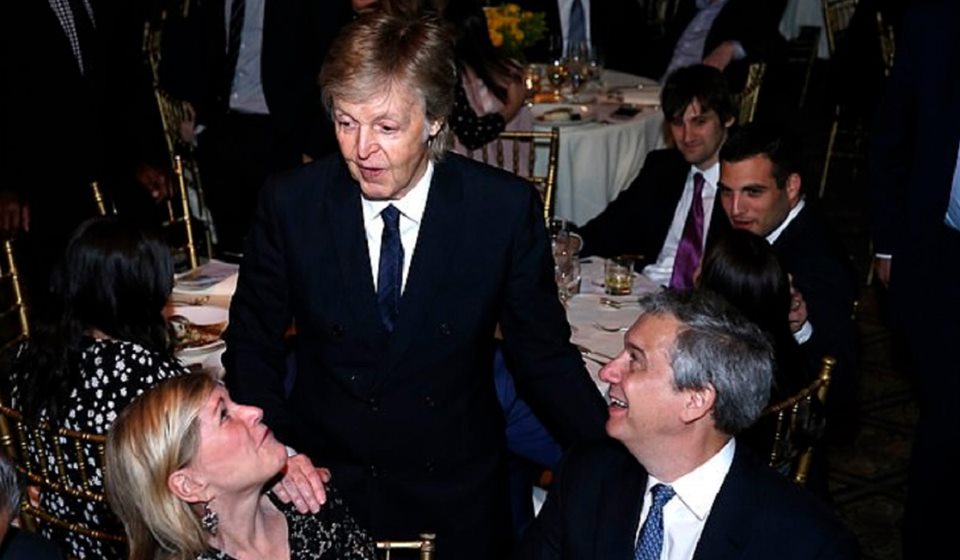
Shmoozing with Sir Paul McCartney!
Always nice to find a story of someone that recently met Paul. On June 4, 2019, Paul and Nancy attended the Jewish Board of Family and Children Services Spring Banquet where Nancy was being honored. This event took place at the Plaza Hotel in New York City. This story was originally found here https://www.aish.com/ci/a/Shmoozing-with-Sir-Paul-McCartney.html?fbclid=IwAR3KkJA8jaV6DPdsGK-htJejF81npigJmdly34rHh31XC0sR_ylj6sf2Uso
As always, I like to copy and paste stories like these to keep in the archives in case the originating site takes it down.


Shmoozing with Sir Paul McCartney
Written by Rabbit Yitz Greenman
June 10, 2019
aish.com
As always, I like to copy and paste stories like these to keep in the archives in case the originating site takes it down.

Written by Rabbit Yitz Greenman
June 10, 2019
aish.com
I went to a charity dinner last night and sat two tables away from Paul McCartney. Born a few weeks before the Beatles performance on the Ed Sullivan Show in 1964, I – like hundreds of millions of others - have been greatly influenced by Sir Paul. There was no way I wasn’t going to introduce myself. After mustering up the courage I went over and shook his hand. He was warm and welcoming. I thanked him for providing generations of people with great music and that I’ve been a lifelong fan. He was genuinely appreciative of my compliment and told me so.
Then I asked him, “Could I ask you a rabbinic question?”
“Please do,” he replied.
“What merit do you have that enabled you to be such a dominant force in the music world and such an influential person for more than 50 years?”
Without batting an eyelash he responded, “I know the answer to that one. My family. I come from a very supportive family. My parents were always there for me and provided an environment in which I was able to flourish. My dad was always behind me and encouraging me.”
He then pivoted by comparing himself to John Lennon. This was becoming a surreal experience. All of a sudden I’m having a real conversation with Paul McCartney (!) and I felt (uncharacteristically) totally out of my depth.
So I can’t remember if he was contrasting his life to John Lennon’s by saying, “You know John Lennon didn’t have that supportive family upbringing that I had” or comparing it and saying “You know John Lennon had this support network as well.” I was just so mesmerized by Paul’s warmth and openness that I lost the content of his comparison.
Then I responded – and I admit it was a most arrogant comment, “I think your merit is due to something else.”
His reaction was fascinating. He didn’t say, “You don’t know me. How can you presume to know what merits I have?” Rather he said, “What do you think it is?”
Paul McCartney was actually curious to hear my thoughts! His humility was so disarming. I shared that over the years I had read that he had written songs and given them to other artists to perform. I told him that I saw an interview of him where he described bumping into Mick Jagger and Keith Richards in London in the early 60s and they were down in the dumps because they needed a good song to cut. Paul gave them one.
“Is this story true?” I asked.
“Yes, I gave them the song I Wanna Be Your Man and they sang it.”
“Wow. That’s a tremendous act of kindness, one that gives you incredible merit to deserve great gifts from Above.”
“Thank you,” he said, “but I think my answer is right. It was my family’s love and support.”
“But you didn’t listen to your dad,” I joked.
Here too Paul was curious and not negative in any way. His face read: “Please tell me how I didn’t listen to my dad.”
“I heard that your father told you to sing ‘She loves you YES YES YES,’ not ‘She loves you YEAH YEAH YEAH’ and you didn’t listen.”
“You’re right. He did say that and I didn’t listen,” to which the small crowd gathering around us all laughed.
If you think about it, here too Paul’s greatness shines. I’m asking him what merit he had to accomplish such greatness and he sincerely attributed it to others. I attributed it to his acts of giving and loving kindness in helping others – and he acknowledges the facts but downplays his role. True humility.
I realize there’s a sea of folks wanting to shake his hand and I go back to my table, thanking him for sharing his thoughts. Two hours later, when the dinner officially ended, I walked back over to him to ask for his advice. (By now I’m sure you realize my persistence is endless.)
“Can I ask you for a piece of advice”
“Please,” he responded.
“We have a teenage son who excels at piano and singing. How can we water this flower?”
“Give him love,” he replied.
“Thank God, we give him love. What else can we do?”
“Give him more love. It’s like what I told you before, my father gave me lots of love and that enabled me to write and sing and flourish. This is what you need to do for your son. Love and more love.”
Wait a second. Paul McCartney is now referring to a conversation we had two hours ago? Does he actually remember me? Here’s a man who is approached non-stop every day and he remembered that we spoke? I was touched.
Hoping to score an appointment for my budding musician son, I asked him if he ever meets with young talent. He shared that he goes to Liverpool every year to a music school there and attends their graduation ceremony and meets the students. He suggested sending my son there – not something that is likely. I wanted to ask him if I could introduce my son to him, but I didn’t want to overstep his boundaries any more than I already had (yes, even I have a limit) so I let it go.
I was blown away by my encounter with Sir Paul McCartney. He was kind, open and genuinely humble. Being at peace with himself, he was present and engaged, embodying so many important traits that are necessary for greatness.
Subscribe to:
Posts (Atom)