Showing posts with label Dark Horse at 50. Show all posts

Sunday, November 10, 2024

Beatle Fans Arrive Early


Beatle Fans Arrive Early 

By Kathie Estelle

The Independent

November 11, 1974


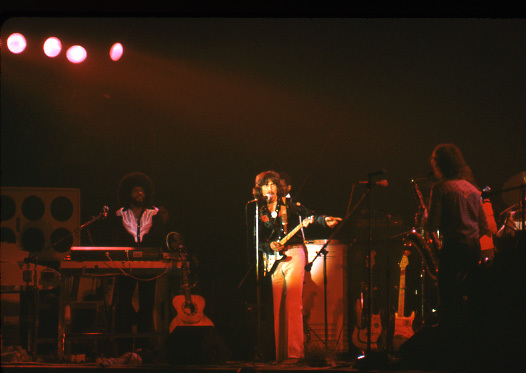
    Festival seating for former Beatle George Harrison's concert Sunday night at the Long Beach arena meant only one thing to his fans, get there early. Festival seating is informal and on a first come first served basis for ticket holders. The arrangement usually means long lines formed hours before a concert, and fans jostle for a position that will guarantee them upfront seats

. By 4pm at least 1000 concert goers were sitting on the dirt and standing on the sidewalk patiently waiting for the 8pm concert. Some eased the boredom by quietly drinking or smoking marijuana and talking among themselves. About 15 persons bedecked in rainbow-colored robes, blew bubbles over the crowd and planted silver stars on people's foreheads. 

    The smogless, 80-degree weather was perfect for the long wait. Other Harrison fans attempted to panhandle enough money to buy tickets. "I know you've heard this rap before," said one girl dressed in blue overalls and a brightly colored shirt, "but I've been offered a $5 ticket, and I've only got $2.50." Minutes later, the girl was handed a $9.50 ticket for the money she had in her pocket.

 The crowd's spirit was lifted by an abundant supply of beer, wine, and other exotic drinks. Among the more creative concoctions was a mixture of chocolate ice cream, mashed bananas, and vodka. The heady brew, like most of the other drinks, was generously passed through the crowd.  Periodically, a few policemen provided security outside the arena and told the crowd to keep in mind, hold their own tickets, and mellow out. 

    Many of those in the crowd responded by joking with the police. The only uneasiness came when the doors opened at 5:30pm, "We're moving!" shouted delighted fans and stampeded for the open door. When everyone was safely inside the arena, Frisbees, large rubber balls and paper airplanes went whizzing over the heads of the crowd. This prompted Producer Bill Graham to ask audience members to throw the objects away from the stage. The crowd cheered and swiftly obliged. 

    Fans then settled in to watch the real show, which was not to start for two and a half hours. When Harrison came on, the audience held up lighted matches in greeting.  Harrison's voice showed signs of the throat problems that have been bothering him, but the audience reacted warmly. However, it was Billy Preston who stole the show with his hit, "Going 'Round in Circles." 

Thursday, November 7, 2024

Harrison better at Oakland Show


Harrison Better at Oakland Show

By Kathie Staska and George Mangrum

The Argus

November 15, 1974


 It was a different story at the Oakland Coliseum Friday at the ten p.m. gig. Although George still had a raspy voice, the vocals were much improved from the evening before, and he came out front with his guitar work and put on a show everyone knew he was capable of. George in Oakland was exceptional, instrumentally, on such songs as "Harri's Goodbye," "While My Guitar Gently Weeps," "Something," Sue Me Sue You Blues"," Give Me Love," "My Sweet Lord," "Maya Love" and "Dark Horse".

Wednesday, November 6, 2024

Harrison in Frail Voice -- The Fuse Goes Out


Harrison in Frail Voice - The Fuse Goes Out

By Philip Elwood

The San Francisco Examiner

November 7, 1974

    It happens even to the best of Beatles. George Harrison's Cow Palace show last night was a fizzle, not a bomb, not an artistic catastrophe, rather more like a smoldering fuse of a potential earth-rocking electric music experience that sputtered along for a short time and then, with "My Sweet Lord", died out.

     Never a strong singer but a moving one, Harrison found that he had virtually no voice left after only two concerts out of the 50 in the nationwide tour and had to croak his way through even the delicate "Something" and such fine numbers as John Lennon's "In My Life." With the strong jazz and blues rock tip behind him, Harrison's vocals usually went unheard when the amplification was turned up for Harrison's voice, and mixing problems developed. Indeed, there was never a time in the 80-minutes that Harrison and his band were on stage that the sound system was properly balanced. Harrison participated, one way or another, in 17 tunes, three of them specialties for organist vocalist Billy Preston and one instrumental featuring feature for reedman Tom Scott.

     The evening's biggest roar from the approximately 13000 in the audience came for Preston, especially on "Nothing From Nothing," and "Let it Go Around in Circles." Harrison was cordial but nervous. He frequently alluded to "Me bad throat tonight" or said, "My voice's really shattered." After the latter, he performed "Give Me Love" later, saying quite apologetically, "We're not sure what you expect to hear, what you want us to play, but what we want to do most is make people happy."

     The orchestra looked good and played marvelously. Preston, as an organist, singer, dancer, and charismatic focal point, was sparkling all evening. Backup guitarist with the solo here and there was Ukiah's own Robben Ford, exuberant as always, swinging and swaying, working one end of the center stage instrumental teeter-totter as whom fulcrum was. Harrison's drummer, Andy Newark, the steady, rich-toned bassist Willie Weeks, and percussionist Emile Richards played everything from vibes to chimes to bells and bongos. Scott was joined by the suburb Jim Horn, also on reeds, and Chuck Findley on brasses, on "Darkhorse." Findley also played flute, making it a three-man flute accompaniment for Harrison's wheezy vocal.

     Besides the two mentioned, there were a couple of other Beatles, numbers "For You Blue" and "While My Guitar Gently Weeps," "What Is Life?" "Sound State of Mind" and "Sue You, Sue Me" were newer tunes included .

The Ravi Shankar family, a 15-member Indian instrumental and vocal ensemble, took over for 50 minutes of the program. Scott remained with Shankar playing flute, and others of Harrison's band played the first and last of the Indian music presentations, one called "The Dentist Song Zum Zum", and the other "Disputes and Violence", a jazz-style arrangement with solo inserts. Shankar led the ensemble much of the time, playing sitar only sparingly. What might have been a relaxing interlude of Indian music turned out, in the light of the lackluster Harrison rock presentation, to be a directionless sequence. 

    When the tour began, Harrison said, "As long as I'm into the motion, I may well cover as many places as I can." He had originally contemplated only eight or 10 shows, rather than 50. I hope he doesn't ultimately regret his decision.

Tuesday, November 5, 2024

A Man of Responsibility


A Man of Responsibility

By Ralph J. Gleason

The San Francisco Examiner

December 8, 1974


Although I didn't go to see George Harrison's concert last month at the Cow Palace, there are some things I would like to say about it from the outside.  

To begin with, I have long since accepted the fact that you cannot have a concert of music at the Cow Palace and rarely at any of the other large halls.  You could have an event, an indoor be-in, a happening, but not a concert.  Acoustically engineering is not yet up to the task, and festival seating is a euphemism for" no place to sit." The inert bodies of the pill heads (whatever happened to grass?) represent a hazard that is even more acidic than physically annoying, and the continual hassles with the tight security are simply not worth the trouble. There are reasons for all of this, which are met for another discussion, but one might wish that the lessons of the '60s sociological research that restraint breeds resistance would be kept in mind.

 However, I would rather listen to the records, except when I have a chance to see someone I like in a small hall or club. It is true too that, almost universally, the reports on the Harrison concerts here and in Los Angeles were devastating. It might just be that one Beatle is only a man and not a particularly good entertainer at that. However, the point I want to make is more sociological than musical. 

One of the main points of the whole new wave of popular entertainers in music dating back to the mid 60s is that they had a sense of responsibility toward their community.  In their day, the San Francisco bands such as the Jefferson Airplane (and the new Jefferson Starship album is the best thing that clusters a talent that has produced in a long time) and the Quicksilver Messanger Service and the Grateful Dead were always willing to help out a good cause. They probably did more benefits than any other groups of musicians in the country, and they gave freely and willingly without cavil.

     They were, to some extent, at least taken advantage of by politicians and others  (remember Bobby Kennedy's abortive rock concert in the park?), but by and large, what they did was good and humane and indicated a deep sense of social responsibility, which I find totally absent from most of the newer groups on the scene. What George Harrison did when he appeared here was in the same order. Not only did Harrison give the proceeds of the concerts to the Haight Ashbury free medical clinic, and it was a lot of money, some $65,000, but he also did something even more impressive to me. He gave up his personal off-stage time, which is really rare.

     Harrison went out and visited the clinic the day after his first concert and spent two hours there talking to the volunteers, the low-paid staff, and the patients. That might not seem like much to some of us, but to a center of economic power such as Harrison, with agents and friends and all kinds of people pulling and tucking at him every waking moment, it represents something very special. 

    I wonder how much time any of our leading public servants, from the governor to the mayor, have spent with those clinic workers. Harrison's gesture was inspiring to the staff and volunteers. I'm sure of that without talking to a single one of them, it had to because of its rarity. Janis Joplin used to do that kind of thing because she thought of herself as part of that community, but few others have followed that example. 

    There is something further to be said for what Harrison did, too, and that is the possible effect it may have on other performers. Harrison is reported to have said he hoped to talk to other musicians and singers and get them interested in things like this, and I certainly hope he does. If there is one thing really needed in the aftermath of the collapse of the whole cultural revolt, it is some sense of responsibility for their community on the part of those who came from it and whose success and wealth have stemmed from its loyalty. The Haight Ashbury Medical Clinic has consistently been engaged for years now, and a really important kind of street-level care with no questions asked.

 For some perspective on the Harrison action, I think of the Rolling Stones, my own favorite for rock music, among with one or more other groups. As much as I admire the Stones artistically, I cannot excuse them for their failure to accept any responsibility for the debacle at Altamont, for the injured and the dead from that horrible affair. They have closed their eyes and their ears and shoved off all responsibility. What a nice gesture it would have been for them the last time they were in town to have given some money to the clinic and even visited it. They certainly have no greater need for profit than George Harrison. Long ago, I learned that just because someone is endowed by providence with great talent, it does not necessarily follow that he is a nice guy. By the same token, it does not follow that just because someone is a nice guy, he is talented. 

Talent and responsibility do not, unfortunately, go hand in hand, much as we might wish they did. But when the chips were down, George Harrison did a manly and humane thing. I don't care if his voice was rough and his performance boring; that is his personal problem, and perhaps personal tragedy, which time alone would allow us to judge and give the man his due. He crossed the street to help his fellow men, his fellow victims, if you will, of this crazy society, and in the doing, he set an example that might well be followed by his peers. I certainly hope that it will be followed. They could do a lot worse things with their time and money, and most of them do.

Monday, November 4, 2024

Full Coliseum Applauds Ex-Beatle


Full Colliseum Applauds E-Beatle

By M.J. Greenwood

The News Tribune 

November 5, 1974


    A capacity crowd at the Seattle Center Coliseum warmly greeted ex Beatle George Harrison and a few of his friends in a Monday night concert. Not counting the concert for Bangladesh in 1972, this nationwide 27-city tour marks the first public concert appearance of Harrison in eight years.

     Seattle was the second stop on the tour. Among Harrison's friends were Billy Preston, and Indian sitarist, Ravi Shankar. The concert opened with Harrison and his rock band performing such classic Harrison songs as the haunting "Something," "While My Guitar Gently Weeps" and a newer Harrison tune, "Sue Me. Sue You Blues."Then, to round off the first set, keyboard wizard Billy Preston played his million-seller, "Will It Go Round in Circles," to a highly appreciative audience.

     After a brief break, the tone of the concert changed from wild, sporadic applause to one of quiet and apprehension for the upcoming set featuring the exotic sound of Ravi Shankar and his fellow musicians. The music in the way that it's played resembles somewhat the Western style of jazz and classical improvisations in that there are melodies within melodies and no established time lengths of the works. At the end of the Indian music set, the Western musicians joined them in a rare collaboration of a Ravi Shankar song with inspired results.

     After another brief intermission, Harrison and his friends returned for such hits as" In My Life", "For You Blue,"" Give Me Love Give Me Peace on Earth," and a possible Harrison single, "Dark Horse," named after his Dark Horse Record label.  Billy Preston sent the crowd to a new frenzy with "Nothing From Nothing" and the rocker of the night, "Outta Space", featuring Preston dancing a jig the length of the stage.

     Harrison's finale, the song that was about all of us, was the moving "What is Life." After the thunder standing ovation, Harrison offered his encore. The song was probably most associated with his name, "My Sweet Lord." What also made the concert such a moving and impressive affair was the fact that all proceeds from the concert booklets that were sold during the show, plus a great amount of the money made from the concerts, will go to charitable organizations in the US as well as abroad.


Sunday, November 3, 2024

George Harrison: Weak and Feeble at Start of Tour


George Harrison Weak and Feeble at the Start of Tour

By Jeani Read

November 4, 1974

The Province (Vancouver, British Columbia)


    It was George Harrison's concert, his first North American appearance since a concert for Bangladesh in 1971 and the debut of a seven week tour. 

    And for a long time, all I could think about was Dylan. Bob Dylan. A few months ago, making his first tour in what seemed like forever, singing all his songs wrong for the people who wanted to hear them the way they were used to hearing them.  Harrison sang most of his songs wrong, too, except the painful difference, and it was painful, was that Dylan was in complete control of what he was doing. It was an extraordinary experience in image, breaking a personal integrity, if you will. And George, well, George didn't seem as if he knew what he was doing at all. 

    The double image kept reoccurring, reinforcing at first by the fact that when Harrison stepped up to the mic to sing, His voice sounded curiously broken and Dylanesque. Except Dylan has always sounded like that, and now he was pushing it, fighting and almost venomous, powerful and acidic, and George was weak and feeble.

     Dylan, authoritative and uncompromising. Harrison, bobbing and smiling hopefully through gaunt cheeks. I'm back. Do you like me? Please? 

    Dylan surrounds himself with strong musicians, splitting the show with him and still incontestably dominant. Harrison does the same, but he is unable to dominate anything that happens and too often embarrassingly upstaged.

     On Saturday, the evening started, hopefully enough, with George and the band delivering an almost southern Allman-style instrumental while his Dark Horse record label logo unfurled on a huge screen above the stage. Two Indian characters representing universality lit up the side curtains, anticipating the imminent arrival of Harrison's spiritual and showbiz companion, Ravi Shankar.

     The previously silent, perhaps reverent, crowd packed into the Coliseum broke into a rewarding, sparkle, lit ovation, but the following three hours did little to inspire a similar response, rendering the audience, with rare exceptions, to a state of long suffering.  

    The band, three horns, drums, guitar, precussion, bass and Billy Preston on keyboards has impeachable track records. It featured such people as Tom Scott on sax and woodwinds, Andy Newmark on drums, Willie Weeks on bass, and Robben Ford on guitar. Their credits reach from Jimmy Dorsey and Buddy Rich to Sly Stone and Scott's own L.A. Express.

     But the sound was poorly balanced and erratic, and the band, through the first four selections that included a number from Harrison's own Material World album and his Beatles legendary "Something" never galvanized into a satisfactory working unit.  It was not until at least Billy Preston took over with a strutting version of "Will It Go Round in Circles."  Here, the saxes, trumpets, and rhythm section felt considerably more at home. At last, something to hang some meaty horn lines onto, something to lean and dig into, which they did, and that's pretty well how it went. 

    George kept on singing his sweet, mild tunes off key, pathetically struggling through his edgy range, offering some nicer guitar licks, but rarely any head turning great ones.  And Preston, who was out front and centered only twice more "Outta Space" and Nothing from Nothing", didn't even have to try to steal anything from the star. Just a couple of tightly punctuated organ hits, a shot or two, and it was stolen.

     Even Georgia's best shots, "Sue Me, Sue You,"" While My Guitar Gently Weeps","Give Me Love" were received with nothing like the kind of enthusiasm that Preston's efforts earned. You couldn't even get away with calling it good pacing. And then there were, of course, Ravi Shankar and his dozen plus family who occupied 45 minutes in the middle of the show in what was not so much a cultural exchange as a cultural gap, very nice innovations, and shortcut ragas, compositions based on various Indian folk tunes, an orchestra of instruments and voices hypnotic, changing textures, flexible, impossible rhythms. 

    Shankar first conducting and then playing the audience polite and surprisingly receptive, but the twain never managed to meet, except perhaps in a later moment, when, with both contingents on stage at the same time, they delivered an intriguing mix called "Dispute and Violence". Otherwise, George said,"as jazz."

    So after a night of musical raggedness, concerted physical leaps, and get it on soul training. Anti rock star Harrison closed with "My sweet Lord.", It is refreshing to find in a performance press biography, (although unfortunately fraught with suspicions of plastic virtue), that his personal ambitions now are to have no personal ambitions and that his professional ones are to do a worthwhile job and to leave it vaguely completed. But if you stick to that, you end up with a concert tap that feels even less than vaguely complete, And it is anything to pay $10 for.

50 Years later -- the Dark Horse Tour


In commemorating the 50th Anniversary  George Harrison's only tour in the United states, now known far and wide as the "Dark Horse Tour"  I will be sharing how the press saw the tour by posting some newspaper reviews from each stop (that I can find) along the way.