Showing posts with label beatles break up. Show all posts

Tuesday, February 24, 2026

What the Other Beatles Really Think of Paul McCartney (1971)


Let's take a look at what the UK papers were saying about the Beatles 55 years ago. (George was not having a good birthday)


What the Other Beatles Really Think of Paul McCartney

By Sketch Reporter

The Daily Sketch

February 24, 1971


     A High Court judge heard yesterday what the other Beatles think of Paul McCartney. John Lennon, George Harrison, and Ringo Starr were given written evidence on the third day of McCartney's bid to break up the group and have a receiver brought in to act as financial caretaker. 

    Mr. Justice Stamp was told that the Apple base was in chaos after the death of manager Brian Epstein. "It was full of hustlers and spongers," said Lennon. Two company cars disappeared, and the firm was found to own a house which no one could remember buying, but Paul opposed the appointment of Allen Klein, who later restored order. Klein, an American, dismissed incompetent staff, stopped lavish hospitality, and sent the Beatles regular bank statements. Lennon's statement said.

 "Paul always made things as difficult as possible for Klein," said John Lennon. "The other contenders for the job of manager had been his father-in-law, Lee Eastman, and Eastman's so,n John. John Eastman was an inexperienced, confused, and hysterical young man, and his father was quick-tempered and abusive. 

    "The obstructions and difficulties that made for Klein made George and I decide to sack them as our solicitors, "Lennon continued. "Paul's criticisms of Klein may reflect his dislike of the man, but I don't think they are fair. Klein is certainly forceful to an extreme, but he does get results. He doesn't show discord between us. 

    "Records were selling well, and there were higher royalties than before Klein reorganized the Beatles. Paul acted selfishly and unreasonably. He was being wise after the event and saying that in 1968, musical differences between them became more marked from our earliest days, George and I on one hand, and Paul on the other had different musical tastes. Paul preferred pop-type music, and we preferred what is now called underground."

    "Squabbles with Paul flared into a bitter row on the film set of Let It Be," said George Harrison. "Paul, as the leading composer of the group, had always adopted a superior attitude towards his music. To get a peaceful life, I always let him have his own way, even when it meant that songs I composed were not recorded, but I was having to record his songs and put up with him telling me how to play my own instrument. 

    "Matters came to a head," he said, "in a dismal and cold film studio in Twickenham. When we were in front of the cameras, Paul started getting at me about the way I was playing. I decided I had had enough and told the others I was leaving the group."

    . He was persuaded to return after Paul agreed not to try to teach him how to play. Of the Klein- Eastman affair. George said, "Paul seemed to have a totally closed mind and would not give Klein any fair opportunity."

     "Paul always wanted his own way," Ringo Starr declared. "He was the greatest bass guitar player in the world, but also very determined."

     Ringo said that when it was decided that Paul's solo album, McCartney, should be delayed because of his own solo LP, Sentimental Journey, and the group album, Let It Be he went to see Paul. "To my dismay, he went completely out of control, shouting at me, prodding his fingers toward my face, saying, 'I'll finish you now,' and 'you'll pay!'"  Said Ringo, "He told me to put my coat on and get out. I did so." Ringo added that he was "shaken."

     "While I thought that Paul had behaved like a spoiled child, I could see that the release date of his record had a gigantic emotional significance for him."  As a result, the release dates were altered with difficulty. Ringo's evidence ended, "My own view is that all four of us could even yet work out everything satisfactory." 


The Last Time They were Pictured Together

By Shaun Usher

Daily Sketch

February 24, 1971

Photo by Monty Fresco


    "Yesterday", Paul McCartney's hauntingly nostalgic song titled fits this exclusive picture of the Beatles last informal board meeting. It happened nearly 18 months ago at John Lennon's £125,000  mansion near Sunningdale Burkes.

     Top people have a phrase for such moments--- a golden oldie. Paul, Ringo, John, and George sat around a plain wood table on ornate but uncomfortable antique chairs. John, from habit, sat at the head, enjoying the only chair with arms and Paul's beloved sheepdog, Martha, roamed restlessly, a non voting observer at the gathering.

     The four spent a few minutes discussing songs and discs. Then the Apple overlords meeting ended.


 George to fight ban on driving.

     George Harrison is appealing against the one month driving ban imposed on him yesterday. Mr. Martin Polden, defending,lodgedthe appeal immediately after the disqualification was announced at London's Wells Street Court.

     Harrison, whose record, "My Sweet Lord", is top of the pop charts, was banned from driving a car three times into a policeman's legs. He was also fined £25  with £15 cost after pleading guilty at an earlier hearing to a charge of driving without reasonable consideration. 

    Mr. Polden said the Beatle had been caught in a busy traffic junction. He was in his wife's white Mercedes and slowly drove three times into the legs of the officer who banged on the roof of the car in a bid to stop him. He did not know he had touched the officer and was not capable of driving deliberately into a police officer and causing him hurt. He took the whole business impassively, rather than arrogantly.

Sunday, January 25, 2026

A Conversation with the Beatles Drummer (1971)


 Ringo:  A Conversation with The Beatles Drummer

By Michael Watts

Melody Maker

July 31, 1971


MW:  Musically, what are you doing now? 

RS:  Well, I'd like to get into an album when I get back, I think. At the moment, I'm working on the title song for this film, which I've written, and when I get back, I'll have to record and then take it back to Rome to fit with the film. But then I think I'd like to get into an album. It'd be like, "Don't Come Easy." One of those, --it'll be poppy.

MW:  Are you writing a lot now?

RS: I'm the king of the first verses. I get a first verse, then it takes me another year to finish it. I have a lot of tapes with bits on it, then I put them together.

MW:  Do you compose on guitar? 

RS: Yeah, Klaus is teaching me guitar. It's interesting because I played in E for the past 10 years, and now I can play all the other chords, and with not knowing, I just jump into strange chords that no one seems to get into. Most of the stuff I write is in 12-bar anyway, then I take it to my friend George, who puts in five more chords. And you all say, 'God, look at that! See the way he wrote that song with all those chords!' Ha ha ha. But I usually write it in three. 

MW: In fact, you've always written songs, haven't you? It's just that none of them have worked out so well up to the past year or so.

RS:  Yeah, right. I used to write new words to other people's tunes and never knew. I'd write, 'You Win Again by Jerry Lee Lewis, 100 times. All those Jerry Lee B-sides that I know and love, I'd write them all again. And some would say, 'But that's that'. And I'd say, 'Oh Christ!'  And I wouldn't realize.

     It's only now that I'm getting a bit original. I can write like a job. I have to be holding the guitar or sitting at the piano, and something just comes. I can't sit there and think 'Now I'm going to write'. I think John can work at it, or he can get into it quicker. I must get a flash and then work off that. If I don't get the flash, it's impossible for me. 

MW:  We spoke about sessions yesterday. How many have you done since the Beatles? 

RS:  Well, last year I played on nine albums, and I was mentioned on only three. We go through a scene because of EMI. If I play with someone, we have to have a release, or I change my name. So look out for Big Jimmy and Richie.

     I have different names every time, which is good fun for us. I've been playing with everyone lately, and it's interesting because of the styles and different guitarists. I think Klaus is, for me, the greatest bass player to play with now. Klaus and I suddenly turn into Bill and Ben. You know, we play on every session together, and Gary Wright and  errr.....Eric was fantastic to play with, but he doesn't seem to play anymore. You can put that. Maybe it'll jolt him out of it. Don't say anything more than that. 

MW:  Do you guys let BB King and Howlin' Wolf ring you up to play? Or do you volunteer? 

RS:  Yeah, people usually phone me or get me through someone they're playing with who knows me, and if I feel I can relax there, I'll play with them. I'll play with anyone you know, but I like to know at least one person there. It's hard to go into a completely 'don't-know-nobody' situation room and play. Playing is hard, and to get together is harder. 

MW: You don't think people ask you to play just because it's Ringo Starr ex-Beatle?

RS:  No, the people who call me up only want me because of the way I play, usually because of what they do. 

MW: The Howlin' Wolf sessions aren't coming out, are they?

RS: Not, from what I know. Anyway, the sessions I played on, I think we're scrappy. I only played on one night. Howlin' Wolf is great, though. He'll come around to you, singing to you all the blues. You have to get through that thing first. 'Well, look at me with Howlin' Wolf, one of the greatest blues singers of our time, and there's little old me playing with him.' 

    That scene you go through that-- something blows your mind. You know, BB, you can get closer to, because he's playing guitar. Howlin' Wolf didn't play; he just sang. Eric played guitar, and another guitarist called Charles... someone, I think, was his name, who is with Howlin' Wolf, but BB and Howlin' Wolf are no more important to me than sessions with John or George.

     No one plays rhythm like John, and I think George must be the best rock guitarist around. John has some good moments, like the slide on, 'Get Back.'  John is good lead because he's crazy. I don't know if the word is 'erratic,' but he plays lead like an amateur, yet it comes off. It's not a put-down. He plays mad things like old blues guys. 

    You know, when we did Howlin' Wolf, Eric was just--- he had this guy with him who played everything incredibly simple, but he blew Eric's mind, because Eric would never think of going that simple like my chord technique is because I don't know, it's like a child. I do it like a child. I mean, children's paintings are fantastic. 

    Zak, he does these paintings, you won't believe, and they're all doing things like something's in the air, jumping on that, and that's jumping over there against this over there, and the sun suddenly bouncing down. And people say, 'Oh, no, of course, you got to have the sun over there, and the shadow must fall to the left.' They're not into that. But that's how I play. It's just anything. 

    I think T-Rex are fantastic while I think of it, I think they're doing the best stuff now they've ever done. It's like when we went to Dylan concerts, when he brought The Band with him for the first time, and the five guys stood up in pullovers and said, 'Oh, terrible Traitor, traitor.' It gets bad when people won't allow you to do what you want to do. 

    We've created an image for them to either buy or not buy, like a loaf of bread. You like this bread or you don't like it.

   MW:   I've asked you about the albums of John and George. What about Paul's?

RS:  I feel sad with Paul's albums, because I believe he's a great artist, incredibly creative, incredibly clever, and he disappoints me on his albums. I don't think there's one tune on the last one, Ram. There's a couple of lines-- that's all. It's too tricky for me. I just feel he's wasting his time. It's just the way I feel.

     I think it's such a pity that he doesn't get in there and do what I think he can do, and I'm sure he knows he can do. He seems to be going strange. It's like he's not admitting that he can write great tunes. He wants to do a tricky, rocky thing, which he can do anyway. I mean, Paul is fantastic, but he won't admit to the nice tunes he can write. I don't know. It just seems to me that he's getting a bit ashamed of them. He's trying to have another image. He picks the image of his choice. You know, I just feel he's let me down.

MW:  You get on okay now, though, do you?

RS: It's got better. After the case, we phoned each other and talked a bit. But while we were being hassled with the court case, it was a bit strange. I just kept thinking, 'What's he doing it to me for?' But then I realized he's got to do it to get what he wants. Is the only way. So I don't put him down for it.

MW:   After the case, was there any ill feelings?

RS: Not really, the only ill feeling was that it was such a bind. It (expletive) your mind up to play a bit. You know, you get lawyers coming around all times, day and night, millions of affidavits, too many problems that I just  didn't want to do because I just wanted to play. But we had to go through it. You've got to stand up and go through these things that someone lays them on you. And we had to do that. We got a bit of cat-calling, which really wasn't right, but there's nothing you can do. Suddenly, your brain gets twisted, and you do strange things. As a person, I can't help but love him. I really can't. He's very important to me. 

MW: Do you ever see him socially now? 

RS:  No, he's always in Scotland. Mick's wedding was the last time. That was a bit strange, because we hadn't seen each other for a year, but we both knew that everything was okay. I'm not gonna ----none of us are gonna punch each other or anything like that. It was just like we hadn't seen him for a year. So it got like, 'hello,' you know, and we had to get warm together.

MW: I get the impression, though, that there was maybe one time when it would have come to blows. 

RS: No. It would never come to blows.

MW: What about the story that John and George sent you round to Paul's to ask if he'd hold the release of his albums so it wouldn't interfere with the sales of Let It Be?

RS: They didn't send me round. It's a misquote. The letters were ready there. They, as directors of that company --were all directors of different companies, wrote a letter to him, and I didn't think it fair that some office lad should take something like that round. I was in the office at the time and said, 'Give it to me.' No-- I was talking to the office, that's right, and they were telling me what was going on. And I said, 'Send it up. I'll take it round.'

     I couldn't fear him then, but he got angry because we were asking him to hold his album back. And the album was very important to him. After I left his house, I mean, it's all been said in court, as it were, he told me to get out of his house. He was crazy. He went crazy. I thought I got brought down because I couldn't believe it was happening to me. I just brought a letter. I said, 'I agree with everything that's in the letter', because we tried to work it like a company then, not as individuals. 

    I put my album out two weeks before, which makes me seem like such a good guy, but it wasn't really because I needed to put it out before--- else it would have slayed me. Paul's album, and it did. 

MW:  It's not true that he physically attacked you?

RS:  No, he just shouted and pointed at me. It's funny now. Everything gets funny two years later, but I'm very emotional. Things like that really upset me at the time. It's only like a brother. You know, you mustn't pretend that brothers don't fight because they fight worse than anybody.

MW: Can you give your version of the reason the Beatles split?

RS:  Hell, there's 100 reasons: because I left, because George left, because Yoko came in, because John left, because of the business, because suddenly we weren't thinking together. Suddenly, we had individual things to do, millions of things. They're all part of it. You know, little niggly things that crop up because we've been together for the past 10 years and suddenly wanted to do different things.

MW:  Do you think it was inevitable, since there were four strong individuals, that you split? 

RS: No, not inevitable. It only got to break up when we all decided, 'let's do other things besides the Beatles'. But I really would have liked to do individual things and the Beatles thing. The Beatles, we were a great group. We were a good group, man, and there was a lot of good ideas and a lot of good music came out of them. Individually, a lot of good stuff came out as well. But as a four, the best stuff came out. 

MW: You think, musically, that you were the best as the four Beatles, rather than the four individuals?

RS: It was good, because after 10 years, we knew how to play together. After every album, we all went on holiday and came back for the next one. We took a few weeks to get together, but it was easier because of all the years that went on before. It takes a while, like the BB sessions, the first night wasn't that good, because no one knew each other, and you couldn't get in with them.

     I play a bit crazy, and they didn't know what was happening. And the guitarist does a few things, and I'm not following him, right? So it takes a couple sessions to get into how people play, and then you play good. That's why the last night with BB was the greatest session this year. It was just incredible. It blows your mind. That's why music is important to me, just for those days. That's why I think it's more important to me than acting.

MW:  Can you say when the first cracks appeared in The Beatles setup?

RS:  I think on the White album.

MW: Was there trouble in the studio?

RS:  No, we never really argued. That was the funny thing. We always sort of held back a bit. And maybe if we argued a lot more, that wouldn't have got to the stage it got to.

MW:  Why do you say the White Album?

RS: Oh, I left on the White Album. I had to leave. I thought the other three were together, and I wasn't with them. I was separate. I was feeling down. Also, I thought I wasn't playing right. But I went round to each one and said, 'Look, I've got to leave. I can't make it.' But then each one I went to said, 'I thought it was you three, and I was on my own', so at least we cleared it up that we all were thinking a bit like that at the time.

     So we got together again, we sorted that out, and then on the Let It Be album, George had to leave because he thought Paul was dominating him. 

MW: That's evident from the movie. 

RS:  Well, he was because Michael Lindsay Hogg (director of the film) liked Paul, I would think more than the rest of us. So it's like Paul's film. Actually, it was supposed to be 25% each, and I've got about two shots. You know, I did a lot of me comedy for him. I ran around, hiding, peeping, and looting, but they never used any of it.

MW:  Let's talk about the maharishi. You were the first to break with him. Do you think he made fools of you? 

RS: No, no. I'm pleased I met the Maharishi. It's one of the nicest points in my life, meeting him. At the time I was going through a few scenes, and I believed him, and he straightened me out on a few things.

MW:  Like, what exactly? 

RS: Well, one of them was that I couldn't understand why we weren't involved with nature and animals. I really believe that we're all together in some way. The forces are all together, and suddenly all the animals are being killed. All the land is being destroyed.

MW:  You're a great believer in ecology, aren't you? 

RSL Yeah, right. I think it's important for us, but I was really brought down.  The whole world is just getting (expletive) up. And I was talking to him, and he was saying that all the forces are important together. All these trees and flowers have a purpose and can help you, and we can help each other. And we were just (expletive) it up. I was getting pretty down on it. 

    I just sit in the garden and look at the trees and think, why the (expletive) is everyone just (expletive) the place up?  If we just take a carrier bag and put all our (expletive) in it and burn it, we get rid of it. But there again, burning doesn't help (expletive). It all goes in the atmosphere, and we get no sun or something. I was just getting a bit down, and he gave me a mantra, which I'll have for the rest of my life. If things ever get too heavy, I can meditate and get out of it. 

MW: You still meditate, do you?

RS:  Not very often -- occasionally. He gave me a gift, you know, that no one can take from me ever. And I thank him for that. I'm always pleased I met him. 

MW: He was one of those people who hang around the big groups like The Beatles.

RS:  No. No one knows this, but he didn't know what the Beatles were. He was one of the few people in the world who had never heard of them. And when it was 1967, we were monsters then, and he never heard of us.

     John and George went to the first thing, I think he had a big meeting in the Hilton, a big conference, some ball----anyway---and I got back that night, and there were all these phone messages on my answering phone saying, 'Going to Bangor, you got to come. This guy is incredible.' And so I met with them in the morning, and we went to Bangor, and we got off the train. And of course, the press got us leaving London, and wired Bangor, so there's like 5000 kids there.

     And he got off the train thinking, 'Wow, I must really be getting big in Bangor!' He really thought it was for him. He was so naive.

MW: Didn't he use you, though, afterwards to further himself? 

RS:  Yes, he did after he realized, but all I'm saying is that at first, he never knew about us. When he realized that suddenly we could attract these crowds, his aim in life was to get the whole world meditating, so he thought, 'I can use them.'

     He wanted us to do a world tour and would open a camp wherever we went for meditation, because that was his life. But he never actually used us. We never did anything for him. We never paid him one penny. The only money we ever laid out was our airfare to India. We never gave him anything. 

MW:  You're not associated with mysticism anymore, then?

RS:  I really believe it. The only difference is that now it's not running my life.

MW:  How about your LSD period? Do you regret taking the dope now? 

RS:  No, I can't regret it in a total way. In certain ways, I regret it, like I wish I had gotten to that stage without it. I really think it opened my eyes a bit and opened a few passages in my brain. But I wouldn't advise anyone ever to touch it. I would never touch it again. You see, once you've taken it, there's no going back. You've done it then and gone through it. 

    So I've come through it, and my only regret is that I wouldn't have liked to get where that took me. I wouldn't like say it was very high or low, or anywhere. I would have liked to get there without any.

MW: How many trips did you take in all?

RS:   About nine.

MW: Were they all good?

RS:  Good and bad, some extremely bad, some extremely good 

MW: Did you see God as so many claim they do?

RS:  No, I can't understand that concept. You just see something that relates to what you were thinking at the time. I think that you were sure of it sometimes, it's like an answer to a question that you couldn't answer before you took it. It's back again to whether the answer is right. But I went through a lot of good scenes with it. It's mainly not enforced, not certified. What's the word I'm thinking of?

MW:  Reaffirmed? 

RS:  Yeah. Reaffirmed. Reaffirmed. A few things. For me, it opens your eyes. You know, I wouldn't like none of this in the paper, because it's one of these where maybe some kids will take the shit because of something I said. And I wouldn't like that. I'm telling you not to take it anyway. You can write that.

MW: You're not into dope of any kind, not even grass?

RS:   No. I mean, I'm into grass, just old times. But I don't want that (expletive) either. That's the thing. I want to do it by myself. It gets very hard.

Wednesday, December 31, 2025

The Final Rift (1970)

The Beatles:  The Final Rift
By Ray Connelly
Evening Standard
December 31, 1970


    Paul McCartney's application to the High Court for the winding up of the Beatles' affair is not unexpected. It is the legal end to a situation which has been inevitable for many months, but it could turn out to be a very messy affair. 

    The Beatles as a group broke up 15 months ago when John Lennon told the other three that he wanted a divorce from them. His new life with Yoko Ono left him no energy or interest for the Beatles, and he set about making a career for himself .

    For a time, his decision was kept secret. Meanwhile, enormous friction was developing between John and Paul over John's decision to bring in American businessman Allen Klein to run the affairs of Apple the Beatles record company. 

    McCartney wanted his father-in-law, Lee Eastman, a New York lawyer, to manage him. Last March, McCartney made the split between the Beatles public when he brought out his own first solo album. But at the time, he appeared to be leaving a few avenues open, should the situation improve. 

    But since then, the relations between Lennon and McCartney have been nonexistent. For much of this year, Paul stayed on his cottage farm before going to New York in the autumn to make an album. So far, there is no sign of that album being issued. 

    Now it looks as though Paul wants to get out of Apple and away from Allen Klein completely. But efforts to break up the affairs of the Beatles could be very, very complicated. 

    It is sad to see the affairs of the Beatles now end in public dispute. Both John Lennon and Paul McCartney have been playing together for practically half their lives. (They met at a village fete outside Liverpool when Paul was 14; he is now 28).  And until the last two years or so, they were the closest of friends. 

    But the different types of women that all four Beatles married indicate the underlying differences in their personalities. While John, George, Paul, and Ringo may once have been friends, it is difficult to imagine avant-garde artist Yoko Ono, model Pattie Harrison, photographer Linda McCartney, and former hairdresser Maureen Starkey having a great deal in common. 

    Nine months ago, Paul told me, "The Beatles have left the Beatles, but no one wants to say the party's over. John's in love with Yoko, and he's no longer in love with the other three of us. And let's face it, we were in love with the Beatles as much as anyone. 

    "We're still like brothers, and we have enormous emotional ties because we were the only four that it all happened to. I don't mind being bound to them as a friend. I like that idea. I don't mind being bound to them physically, because I like the others as physical partners, but for my own sanity, we must change the business arrangements we have.

     "Only by being completely free of each other financially will we ever have any chance of coming back together as friends, because it's business that's caused a lot of the split."

     He went on, "We should all have our independent incomes and let us work out for ourselves the company problems.

    After all the years of work, all I've got to show is money locked up in a big company. "

    The Beatles shot to world prominence in 1963 when, under the guidance of Liverpool manager Brian Epstein, they became the biggest entertainment attraction ever. 

    At a conservative estimate, the record sales in the seven years must be well over 250 million copies. While their incomes have been equally staggering.

     They have appeared in three films: A Hard Day's Night (which was shown on BBC television on Monday, and appeared woefully old-fashioned),  Help!, and Let It Be. During virtually the whole of the 60s, the western world was obsessed with the Beatles and their many fads, but the effect upon the four individuals involved has been staggering. 

    They became the greatest show business phenomenon ever known, but their private lives could hardly be less glamorous. Now, all four live as quietly as possible.  John, Paul, and George are in situations that are very close to isolation, and all four have a cynical disregard for the trappings of show business. 

    We'll all be sorry to see them go forever, but it was inevitable. We all grow up. 

Tuesday, April 11, 2017

The Beatles are Finished!


Yesterday marked the 47 years since newspapers around the globe informed us that Paul had quit the Beatles.   At the time, the announcement was confusing and some fans were in denial that the Beatles were over for good.  Surely they were just going to do some solo projects for awhile and then get back together as the Beatles, right?    Of course fans did not know at that time about the law suits that were about to occur.   

Here is an interesting story that I found in that scrapbook.   I am unsure of the date. 


Paul McCartney, in his first magazine interview since the split, tells FLIP's Keith Altham...
"THE BEATLES ARE FINISHED!"

The Beatles and FLIP have always been close.  The first magazine FLIP editor-publisher Steve Kahn ever published was all about The Beatles.  Keith Altham, FLIP's London editor, has long been a close friend of Paul, John, Ringo and George.  And Linda Eastman, now Linda Eastman McCartney was a photographer for FLIP long before she met Paul.

Because of this relationship with the world's most incredible group, FLIP was especially saddened when the break between Paul and the others came  And, deep in our hearts, we believed that, someday, somehow, the Beatles would get back together again.  We believed it until the other day, when Keith Altham cabled this story from London.


"The party is over -  but no one really wants to announce the finish of an institution,"  says Paul.  "I didn't leave the Beatles -- the Beatles left the Beatles.  First Ringo left during our recording of the "white" album because he said it was not fun anymore.  Then George left because he thought we were not saying enough on "Abbey Road."   John fell in love with Yoko and out of love with the rest of us."

The real split of the Beatles' relationship occurred almost 18 months ago, in spite of the fact that their work has been individual efforts.  

"It just became impossible for me to work with Yoko sitting there watching us," says Paul.  "I wanted tow rite simple things like 'I love you girl' and every time I knew she was listening I felt I had to come out with someone clever and avant garde!


"I'm not blaming Yoko -- I'm blaming me.  It was no more John's fault for falling in love with Yoko than it was mine for falling in love with Linda.  It just meant that we didn't work together anymore.  We tried but it didn't work."

McCartney physically left the Beatles almost a year ago when he retired to his Scottish farm and refused to talk to the press for over 16 months.  He had said his bit on behalf of the Beatles, made their excuses, met the verbal demands and charmed the journalists out of the trees for six years.  He had only things to say on behalf of himself and was not prepared to say them while the body of the Beatles still twitched.

Another major difference of opinion arose over Allen Klein being appointed their business manager.  "I don't think we need a manager in the sense that Brian Epstein was our manager," said Paul.  "All I want is paid advisers who do what I want them to do.  I never signed a contract with Klein nor do I intend to do so."

In one sense it might be true to say that the other Beatles left the group long before he made his statement.  Paul felt the group was losing their reality and wanted to make live appearances again as long ago as last autumn.


"I felt we would never get back to the stage of playing good music again until we started behaving like a live band," says Paul.   "I suggested to the others we make unscheduled appearances in little village halls - just close the doors after a few hundred people were in.

"John's reply was that I was daft!"  He then said he wanted to leave the Beatles and wanted an immediate divorce.  None of us really knew what to do about the situation, but we decided to wait until our film 'Let it Be' came out in April.  I got bored and made 'McCartney' instead!"

Paul's solo album came about almost as an accident, he recalls:  "I'd just got a new recording machine in my London house and found I liked recording on my own -- playing all the instruments.  At first it wasn't going to be anything serious.   I had not enjoyed myself as much since the early days of the Beatles.  I haven't really enjoyed the Beatles these last two years."

The Beatles dead?  It seems almost impossible to believe but when you realize the four of them have not been in the studio together since last August, it becomes a reality.  The group which was the standard bearer for Western Youth has abdicated and the throne lies vacant.

"I must admit that I don't want to be the one to come out and say the Beatles are finished, but I do believe that we have finished recording together and that we have finished performing together. "


A UPI article from the newspaper published April 11, 1970


Friday, March 24, 2017

The Party's Over for the Beatles - written by Derek Taylor


I recently purchased a scrapbook full of Beatles goodies, including several articles about the Beatles break-up.   This one written by Derek Taylor was especially interesting to me.   Derek had such an interesting way of writing and expressing things.     I hope you enjoy this article like I did. 


The party’s Over for the Beatles
By Derek Taylor
Sunday Magazine
July 26, 1970

What more emotional incentive to go see “Let it Be” and cry and groove to the tune “Long and Winding…you left me standing here a long, long time ago” than fearing that we never will see them again, not together anyway, laughing and waving and spitting into the wind, not up there, pulling in the crowds, banking millions as if it were a pocketful of change.  What better plug for the album than to bill it as the last chance to hear the world’s greatest group.

On the eve of the release of the Beatles new movie and album “Let it Be,” Paul McCartney said, “I quit,” or “I think I quit,” which is roughly the same thing.  As a publicity stunt, it’s as good or bad as any stunt they ever appeared to pull.  But like every stunt they never did pull, this isn’t one either.  McCartney’s declaration of independence was entirely impromptu, spontaneous and personal and so far had the group’s lines of communication become crossed that none of the Beatles really knew when the album would be out, or whether, nor did they greatly care.

In dispute over the choice of business managers, diverging musically, paying ever-increasing attention to hearth and home, unsure which of them their Apple company should most closely reflect, inching closer to early middle age (or maturity) there was less to bring them together than to keep them apart.

Because their immense collective strength as Beatles was nothing more and nothing less than the sum total of some pretty fierce individual power, it is clear that the future will bring some fine work from the four as separate artists.  But as we have known them, the merry young Beatles are done; it was magic while it lasted and it was very public, but it is over.

It was the longest, most public running news story since the Second World War and no one got killed and if anyone got hurt, it was more by nightsticks than by the music, and then only rarely when the fans over-killed with love.

It was a lovely trip was Beatlemania.   It changed my life and I guess it changed yours, gentle reader:  I hope so, I hope so.

Now that trip is over and how may I do it justice, this joyful adventure which ended not while our backs were turned but in full view of our inquisitive, bulging eyes and within earshot, certainly within earshot?

Somewhere it went wrong for the Beatles and there is no time and no place I can identify and maybe is was not the Beatles that went wrong but that John and Paul and George and Ringo decided that they had to live their own lives, to go right on as humans rather than as Beatles.

I rejoined the Beatles’ staff when they were in India, with the Maharishi, all of them except Ringo who was with his wife Maureen had come back to England because he “didn’t like the spicy food in Rishikesh.”  Paul came back a few weeks later and we talked about the future.  Apple was going to be “groovy but not freaky” and above all it was going to be “business-with-pleasure.”

Apple, the Beatles’ corporation was going to reflect not only them and their dreams (and remember, the Beatles’ dreams had all come true, not without effort, not without pain, not without talent, not without sacrifice, but certainly without rancor and most assuredly all their gains had been realized with total unity:  if there ever was a one for all and all for one, it was the Beatles) but it was going to be an environment for other dreamers and free spirits.

But it was, suddenly, all too much.  Too many dreamers, too many free spirits, too many “freaks,” too many Hells Angels (they came too; one Christmas demanding accommodations, airfares for their bikes and food) too many , too much, too often all the time and everywhere, record me, discover me, house me, clothe me, bail me, don’t fail me.

Give peace a chance, said John, tired of being important; he put his head on the block for suffering mankind, got divorced, went nude, married Yoko, and suddenly the man-in-the-street, never a very steadfast traveling companion, abandoned him.  John Lennon, one of the kindest, dearest men I ever met, acceptable to the establishment when he was “caustic witty Beatle, leader of the pack” was reviled a kook, busted, disbarred from visiting America.

Arriving back from India, still meditating and (contrary to the view promulgated by those who live by put-downs) still grateful to the Mahesh Maharishi Yogi for turning him on to it, George Harrison found it impossible to relate to the snatch-gimmie-grab that met him every time he came through the lobby of the fine $1,500,000 18th century house the Beatles had bought to be their Apple- business – with-pleasure-home-from-home; it spoiled his mind.

Ringo is a very strong cheerful Beatle and Apple seemed to him like a strong cheerful way of binding even closer the four who had come so far and who, then, seemed to have so far to go together.  But for him, too, the queue of souls seeking the shelter of the “umbrella” of which Paul had spoken, was not comfortable.

For Paul, the Apple’s evolution was a shattering disappointment.  It was a four-Beatle trip, but the rocket had been Paul.  He had seen it, as the official Beatles’ biography said, “As a huge corporation with shops, clubs, studios and the best people in the business from cameramen and engineers to artists, writers and composers.”  Everything had to be right, everything.   It was to be totality.  It was t be as perfect a Penny Lane, as absolutely complete as Yesterday.   It had to have grace and style and although many months earlier when I was still a free spirit in Hollywood, he had told me the theme would be “controlled weirdness,” it became clear that later what Paul sought in Apple was not weirdness but a mirror image of his own very remarkable discipline.

With a staff of sixty (and when there were boutique, and electronics, labs and movie division, the staff sometimes topped sixty) the reflection in the glass was nothing like the way Paul McCartney had dreamed it could be and how could it be?  Among sixty people, there are going to be a lot of different trips:  some of them ego and some of them very far out, and none of them looked like Paul’s fantasies. 

First, the shops were closed.  Paul’s statement on the eve of the grotesque give-away when every greedy square in West London with time on his hands grappled and clawed for free good (cab drivers were seen bundling caftans into shopping bags and cops walked off with crimson velvet pants) said, “We don’t like being shopkeepers, we’re artists.”

The electronics department ended too, without anything reaching the market, not because of any lack of inspiration from “Magic” Alexis Mardas, the bizarre and charming Greek who headed it, but because the business men in grey seemed always to be in the way.

None of the four feature films planned for production by the movie department ever got as far as castings; it was also clear that the Beatles collectively would never make another fiction movie.  So….the department closed.

“What is going on at Apple?”  asked the Press.
“Nothing to worry about,” I  half-truthed.

We became, by last year, a very successful record company.  We sure had a lot of hits.  The Beatles’ “white” album was released on the Apple label, and later Abbey Road, Hey Jude, Instant Karma, Come and Get it, Get Back, Those were the Days, Ballad of John and Yoko, Give Peace a Chance, many hits, many millions of records, many millions of dollars.

John and Yoko (in and out of difficulties caused by their determination to be their myriad selves, never a groovy row to hoe), made some very adventurous far-from-the-mainstream albums, formed the Plastic Ono Band, made a success of that, got some very charming lithographs busted for obscenity, and John sent back the MBE.  George met the extraordinary, renunciates of the Radha Krishna Temple, was thoroughly turned on by them and by their Maha Mantra, Hare Krishna, Hare Krishna  (oh yes it does work, try it) and for them, with the instincts of a man who is on a good trip, made a couple singles, both of which were very big hits everywhere except America.

Ringo, a very determined man, left the Beatles for a day or a week because things were getting edgy, returned to complete Abbey Road and then took time out to make a movie with Peter Sellers.  Also, he made his own album, “Sentimental Journey,” using songs his Mum and Dad liked, hiring some great arrangers.  It sold very well, still is selling.  They critics didn’t like it.  How many albums do critics buy?

George, Ringo and John seeing more of each other than of Paul, were also seen more by the public than was Paul.   You just never saw Paul anywhere.  He did go out and about, but he is a master of disguises.  Came the death rumor, which, before it vanished, sold tens of thousands of albums.
The Beatles have been number one with group albums, solo albums, solo singles, group singles, songs sheets, pop movies, television appearances and whatever form 1964 until this very week.  Barring one thing, the future looks extremely bright.  The one thing is that there is no more Beatles:  Paul was the last of them demonstrably to go it alone, though it may be that the minute he recorded the first note of his solo album he was opting out.  And that was months ago.

In his only recent public statement, Paul said, “More than anything, I would love the Beatles to be on top of their form and for them to be as productive as they were.  But things have changed.  They’re all individuals.  Even on Abbey Road we don’t’ do harmonies like we used to.  I think it’s sad.  On Come Together I would have liked to have sung harmony with John and I think he would have liked me to.  But I was too embarrassed to ask him.  And I don’t work to the best of my abilities in that situation.

“I must admit I don’t’ want to be the one to come out and say the Beatles are finished.  I agree that they were an institution and I don’t’ want to go and break them up now I’m beginning to suffer because of all this and beginning to turn the other cheek.

“I suppose really I do believe now that we have finished performing together.  I may not be right, but I must say I’m really enjoying what I’m doing at the moment.  I didn’t leave the Beatles, the Beatles have left the Beatles – but no one wants to be the one to say that party’s over.”

I guess the way it stacks up now and the way it was around the time when Paul dropped the big on is that he wants right out of it all and they don’t.  George was greatly disappointed that Paul should come off like he was injured by Klein (business manager) whom George believes to have greatly eased the effects of the present and insured the safety of the future.

George view is “Did you have to be so nasty.  You can go so far but you can never get back, and you can say things which get in the way forever.  For me, I would be glad to play with all of us again.”
John’s view is:  “Okay.  If this is it, this is it.  We’ve all left the Beatles anyway.”  If Paul were to approach him and say,  “Let’s do it together again,” he probably would; with no more words, he probably would do it.

Ringo?  He was the peacemaker for John, George and himself to Paul and was shaken to find Paul intransigent to the point of saying some pretty blunt things.  But none of the Beatles is vindictive, and pettiness is their natural enemy, and when Paul released his album, Ringo sent a telegram congratulation him on “Maybe I’m Amazed” (one of the tracks) and meant it.  Ringo has a lot of heart and more soul than most and since he knows he will be a Beatles to the grave, he will cooperate should it all come together again.

Around separation time, John was first to hear, by phone, and he told Paul he thought it had actually happened months ago.  George and Ringo read the specifies of it in the London Daily Mirror, though they too had spoken by phone to Paul land they knew in general terms that he wanted to be his own man from now on.

The Beatles used to say, many times and long ago when age thirty was too far away from them to need to be accurate, they used to say, “We can’t be thirty-year old Beatles.”  No more can they and Ringo is thirty in July and John in October and even baby George is in his twenty-eighth year with a beard like Abe Lincoln and the eyes of someone who is getting very deeply into the mysteries of life.
To say they have done it all is to beg the question:  “What is life, if you’ve done it all?”  But have they not done everything as a group that such a group can do without climbing aboard their own myth and riding it like a loop tape into vaudevillian oblivion?


In any case, it will be a long time before they are not contemporary.   It is archive time at Apple and I am starting to chronicle what happened in the sixties when the moptops burst out of Liverpool.  There are many words and pictures and a whole lot of music to shape their story and maybe The End will never be written.  For who could really say “the End” to the Beatles?  Not me man, not me. 

Wednesday, November 16, 2016

The final answer


Whenever I read Paul's "self-interview" that came out with the McCartney album, I never read it as "the Beatles are breaking up."   I felt like he sort of left it open.   And I think in 1970, I would have thought that the guys were taking some time to work on their own projects, but would get back together in a few years as the Beatles and make another album.    Who ever heard of a rock n roll band formally breaking up anyway?    But Paul squashed all of that hope in this August 1970 letter to Melody Maker.

Monday, October 29, 2012

How quickly we forget....

Who broke up the Beatles has been long debated among fans for many years and it will continue to be a debate for as long as Beatle fans roam the earth.    Yoko Ono has often been the butt of many jokes considering the Beatles break-up and for many fans she is the soul reason why the break-up occurred.    So this week, Paul has taken to David Frost to set things straight.  Here is the headlines:


So there you have it, straight from Paul McCartney himself, Yoko Ono did not break up the Beatles.   But wait a minutes.   It seems like the same Paul was saying a totally different story in 1971 to the high court and the headlines were quite different back then:


Now I know that 40 years have past between the two headlines and that over time, you can change your mind about things.    As you mature, your view on why things happened can change.   So I believe Paul today in his views on the break-up, however I find it hilarious to see that he once said the exact opposite of what he is saying today.


Wednesday, July 11, 2012

Break up day

Apple Scruffs singing "Hey Jude" on the steps of Savile Row

George had just walked out and Mal is leading Ringo through the crowd of fans and reporters


Ringo heading towards the car
Someone handed Ringo a hat that he puts on for a second before handing it back and getting into the car

One of the Apple Scruffs with the hat Ringo was wearing smiles for the cameras.
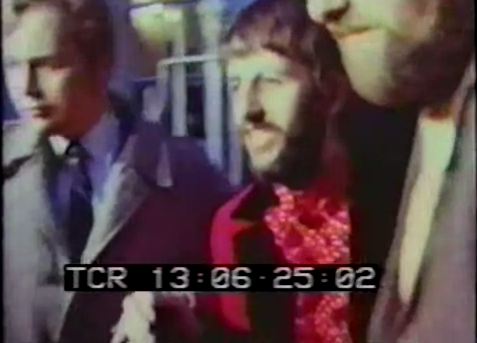
There is a video on youtube (you can find it on Meet The Beatles for Real facebook page) of Derek Taylor and Mavis Smith being interviewed about the Beatles break-up.    The end of that interview shows a reporter standing outside of Savile Row.   You can see the Apple Scruffs with their purses hanging standing around while reporters are trying to get something from them.   There is a very short snippet of them singing "Hey Jude."   Then George walks out (I could hear him say Hare Krishna) and Mal leads Ringo out.

It is interesting footage, especially when you consider that the announcement by Paul that the Beatles had broke up was out that day.   No one there was crying.   I was watching the George documentary and they showed a little bit of this footage and then they showed girls crying.   So this is insane,but I recognized those girls as being from Paul's wedding in March 1969.    So the George documentary talked about the Beatles break up and wanted us to think that people were outside Savile Row crying, so they showed crying fans from when Paul got married.   How deceptive!  As you can see from this footage and screen caps that I made from it, no one was crying on the steps.   I guess one of my biggest pet peeves is people re-writing Beatle history.   I try my best to keep the history intact, but it seems like finding the truth is getting harder and harder.   Okay...my rant is now over.

Tuesday, July 13, 2010

Breaking up is hard to do.


Fans standing outside 3 Saville Row in London reading about the break-up of the Beatles. I was thinking about how today bands don't seem to formally "Break-up." Actually The Beatles are the only band that I seriously think made a formal "break up" statement (who are others?). One of my favorite bands is one that no one ever heard of, The Waiting. They stopped performing and recording together seven years ago. However, they recently got back together and are working on another album. They never really "broke up." They just worked on solo projects and stuff for a few years and got back together as a band. That is how band seem to work frequently. The fans in these photo don't appear to be too upset over the news. I wonder if they just didn't believe it was true.