

An online Beatles fan club for and about Beatle fans
Showing posts with label Billy Preston. Show all posts
Showing posts with label Billy Preston. Show all posts
Thursday, May 14, 2026


Tuesday, February 3, 2026
Ringo Starr Rock "Eldest Stateman" (1991)

Ringo Starr Rock "Eldest Stateman"
Associated Press
February 3, 1991
Tell Ringo Starr, he's one of the elder statesmen of rock and roll. And he interrupts, "I'm probably the eldest statesman," he corrects, but he says it in that Ringo voice, instantly familiar and unchanged, although its owner is 50 years old and light years past his Beatle days.
"Rock and roll keeps you young, if it doesn't kill you, of course," he explains.
Starr has just released Ringo Starr and his All-Star band, a compact disc recorded in concert during his 1989 tour with eight veteran rockers, and he's already thinking about the lineup for another all-star troop.
It's a different Ringo than the one who was better known over much of the past decade for drinking than drumming. And the enthusiasm has as much to do with last year's tour as his 1988 stint in an alcoholic recovery program.
"It was great proof to me that I could actually get up there and play," he said. "And it was great proof that all these musicians that I've known all over the years, you know, still thought they'd like to play with me."
The All Starrs of 1989 were guitarists Nils Lofgren and Joe Walsh, keyboard players Dr. John and Billy Preston, sax man Clarence Clemens, drummers Jim Keltner and Levon Helm, and bass player Rick Danko. Starr admits to wondering whether he could get on stage with musicians of that caliber again, and whether they would want to get up there with him.
"Most of the 80s, I was incommunicado with the planet. And, you know, I wouldn't blame them, you know, because why would they want to get up with this crazy, drunken fool? And I didn't want to get up anyway. I was too busy getting stupid."
Starr and his wife, actress Barbara Bach, spent five weeks in an alcohol treatment program in 1988, and after that, he had to ask himself what he was going to do with his life. The All-Starr band was the answer. "I'm a musician. And we went out there, and we put it together, and it was just a great mind blower that it certainly worked, and we all had fun," he said.
The Rykodisc CD has a dozen songs, but only five featuring Starr: "It Don't Come Easy," "The No, , "No Song," "Honey Don't," "You're 16", and "Photograph." The others were "Iko Iko" by Dr John, "The Wait" with Helm on vocals, "Shine Silently," sung by Lofgren, " Quarter to Three", featuring Clemens, " Reigning in My Heart" with Danko at the microphone, "Will It Go Round in Circles " by Preston, and " Life in the Fast Lane", featuring Walsh.
Starr is intent on getting beyond his Beatles past. "Someone already said, Well, you don't have 'With a Little Help from My Friends,' or 'Yellow Submarine'. Well, you know, that's not the point here. The point is the band that was on tour; this is what we felt would make the best CD."
Starr doesn't know yet who will be in the next All Starr band, because some of last year's members will most certainly have another commitment, but Starr is certain to have an audience, regardless of the compliment. The 1989 tour drew fans ranging from children on up to adults as old as 70.
"Children under seven were let in free with their parents to make the problem of finding babysitters no impediment," he said.
A lot of the kids were more familiar with Starr as the tiny Mr. Conductor on the PBS television show Shining Time Station. The children's show includes a storybook segment from Thomas the Tank Engine and Friends, an English show Starr, narrated.
Sunday, October 19, 2025


Sunday, October 12, 2025


Tuesday, August 26, 2025

Thursday, July 10, 2025


Monday, January 13, 2025
Working with Billy


 |
| Photos by Dick Polak |

January 13, 1970
Tuesday, December 17, 2024
A Pleasant Victory for George Harrison


A Pleasant Victory for George Harrison
By Jonathan Takiff
The Philadelphia News
December 18, 1974
Preceded by reams of negative reviews. Dark Horse George Harrison pulled off a surprisingly pleasant victory at the Spectrum last night. No friends, it was not Nirvana personified, nor even the Inner Light revealed. Especially dampening the fire were the strained and often an often oft- keyed qualities of Harrison's vocals, showing off the fabled rock hero is just another mere mortal among men. His features creased and weathered by time.
But this concert was not the disorganized self-serving venture portrayed by the national music press on the occasion of the tour opening on November 2 in Vancouver. Harrison, it would seem, has taken heed of his critics. The show now moves at a speedy, entertaining pace. Harrison's lean portions, leaving you hungry for more, now concentrate on established hits. Those reluctant to dwell on his past glories, the former Beatle now designs to throw us a bone or four from the halcyon days, including a curiously suitable jazz-up rendering of John Lennon's "In My Life."
Some mid-tour, beefing up of his band, the addition of second drummer Jim Keltner and flutist Jim Horn has also had salutary effects, it would appear.
In the midst of wailing reeds and brass arranged by Tom Scott and the super tight rhythm section, Harrison could hide his pipes' distress, talking his way through "Something" in a burlesque-ish Bob Dylan style, or more sincerely, in the testifying treatment of "My Sweet Lord" the concert single encore,
Harrison makes the most points with the trademark sound of his sweetly weeping guitars riding the high end of the neck in a glissando of spare single notes or bluesy staccato attacks.
In the fashion of his last public appearances, the monumental concerts for Bangladesh held on August 1, 1970 [sic] at Madison Square Garden, George Harrison's current venture strives for an electric variety show approach. As much as not the humble (and uncharismatic) Harrison falls into the shadows to play side man or cheerleader for his friends, Billy Preston, Tom Scott, and the Shankar family of Indian musicians.
Showman supreme Billy Preston actually pulled the most enthusiastic response from the near capacity crowd, first early on in the proceedings, with "Will It Go Round in Circles", then nearing the final lap, with a gospel-tinged "Nothing from Nothing", and his hit instrumental "Outta Space." The latter is boosted by a bit of Rockettes terpsichord by Preston and Harrison.
Aesthetically, the evening's zenith came in the East Meets West fusions of the 16-member Shankar ensemble, led by Lakshmi Shankar, in the absence of her ailing brother-in-law, Ravi Shankar.
Thursday, December 12, 2024
Ex-Beatle George Harrison is guest at White House


Ex-Beatle George Harrison is guest at White House
UPI
December 14, 1974
Former Beatles star George Harrison, wearing red sneakers and expressing "good vibes" about the White House, ate lunch at the Executive Mansion Friday with Jack Ford and met his father, the president.
Harrison pinned a blue Eastern Mystic button with Moon circles on President Ford's lapel and received a W I N (whip inflation now) button in return,
" I didn't ask him about Bangladesh or anything else political," said Harrison after the meeting. "I didn't want to bug him."
Jack, 22, a senior at Utah State University, met Harrison and other rock performers on November 16 after their show in Salt Lake City. He invited them to visit when they came to Washington as part of a seven-week tour.
Harrison, wearing orange pants, red sneakers, and a brown plaid jacket adorned with pop art buttons, arrived in a Cadillac limousine and said he was very flattered at his first White House visit. "I feel good vibes about the White House," added the former Beatle.
After lunch of ham, beef, and vegetables, they went into the Oval Office to see President Ford. He posed for pictures with them, standing between his son and Harrison and joking freely with everyone. Harrison said the president seemed more relaxed than he had expected. "I was the one that was nervous."
With Harrison was Indian satirist Ravi Shankar, singer-organist Billy Preston, and saxophonist Tommy Scott. Also invited were Harrison's father, Harry, his manager, Denis O'Brien, publicity agent Michael Sterling, and two of Jack's personal friends, Ken Smith and Sandy Laughlin,
"I just wanted to return the hospitality." Jack told reporters as he greeted his guests outside. He wore a tan jacket, light-colored jeans, and black boots when he greeted his guests.
" I can relate to Jack and how he feels," said Harrison, "He is a good guy. Everybody's watching everything he does. I'm somewhat familiar with that."
Young Ford, who is studying forestry and expects to graduate in March, flew home from school early Friday morning for the Christmas holidays.
Wednesday, December 11, 2024


Wednesday, November 27, 2024
Concert Mixed Bag


Concert Mixed Bag
No author listed (no surprise with such a negative review)
Jefferson Parish Times
December 6, 1974
To enjoy a three-bean salad, one has to enjoy the taste of each bean because each time a bite is taken, at least two of the beans are in that portion. I'm probably going to get criticized for comparing George Harrison's concert in Baton Rouge last week to a bean salad. But along with Harrison were Ravi Shankar (and his 10 Little Indians) and Billy Preston. All three musicians are popular with some of the people, but all three are not popular with all of the people. Nevertheless, the concert was just like the salad. One had to take two at a time instead of listening to three separate floor shows.
The show began with Harrison conservatively dressed in Ivy League plaid pants and sporting a middle-class sore throat. After singing a few old Beatles tunes, such as "Something" from the Abbey Road album and a couple of new ones on the Dark Horse label, Shankar and a tribe of Indian friends entered stage left; any reminiscent vibrations one experienced about the Beatle legend were quickly extinguished.
Shankar is an excellent musician, but his music conjures up scenes of a harem of belly dancers. I'm not sure a concert of total Shankar and sitar is moving. But when one wants to hear Harrison and his amazing guitar, one has to listen to "Zoom, Zoom, Zoom."
Disappointment cannot help but surface the primary problem with the concert, which was the lack of continuity. No mood was set. One may argue that a mood is not the objective of a concert, that the objective is to listen to music. I disagree because the music can be listened to on a stereo. A concert is attended for the purpose of being entertained. Jumping from Billy Preston's "Nothing From Nothing" to Harrison's "My Sweet Lord" is hellish on the psyche, and it was evident from the lack of enthusiasm in the crowd that the concert as a whole was a disappointment.
Tuesday, November 19, 2024
An Insider's View of George Harrison's Tour


An Insider's View of George Harrison's Tour
By Jon Bream
The Minneapolis Star
December 24, 1974
George Harrison's just completed seven weeks 27 city concert tour, the first by a former member of The Beatles, earned an estimated $4 million. A modest figure by superstar standards. It was neverless a first-class tour, according to bass guitarist Willie Weeks, who played in a couple of Twin Cities bands in the late '60s before working with well-known artists like Donnie Hathaway, Aretha Franklin, Ron Wood, and Harrison.
"It was a gas. The best tour I've ever been on," Weeks reflected this weekend, "a private jet, and it was plush. You walked off the jet, and they handed you a hotel key and room list. They picked up your luggage for you. You just took care of your personal needs and had to be in the right place at the right time."
"They" was the 40-member staff of San Francisco rock impresario Bill Graham's FM productions, which produced the Harrison tour, as well as the more ambitious tours of Bob Dylan and Crosby, Stills Nash, and Young earlier this year. "There was a camper that rushed us out to a gig and took us to the gig," Weeks continued. "After the gig, we went to the hospitality room, where they had dinners set up and anything else you wanted."
Weeks, once accustomed to "lugging my own luggage, taking commercial flights and dealing with uptight commercial people," attributed his comparatively luxurious circumstances to Graham's style and experience with big-name rock stars and to Harrison's insistence on first-class conditions.
Despite the comfortable working situation, Weeks did not feel that it was a superstar tour like the record-setting ten million Crosby, Stills, Nash, and Young extravaganza last summer. "We just got on stage and played as a bunch of great musicians. It certainly wasn't the Beatles. George is George. He's into being himself. I think he wants to remember the Beatles as ex-Beatles."
Weeks was one of a handful of session musicians Harrison enlisted last summer to help him record his recent release album, Dark Horse. Most of the musicians were later invited to join Harrison on the tour.
"We rehearsed for two weeks, but it was more goofing around than rehearsal." Weeks recalled. "A lot of the learning came as we went along on the tour." Unlike other groups composed of sidemen, Harrison's band, Weeks noted, achieved a family feeling. "It seems like we all fell in love with each other. It felt like a band. George, as frontman certainly, with an incredible bunch of musicians. I was no longer the Willie Weeks who stood straight and tall. I let my craziness out on stage."
Harrison asked Weeks to join him and organist Billy Preston each night in a dance on stage, but the basis declined because he felt he could not play and dance at the same time. Weeks did, however, receive a regular opportunity to solo during "For You Blue." "I didn't want to take a solo on that song, Week said, "but George insisted. So, I tried to make the best of it. It was a standard 12-bar blues, and I had 24 bars to play, but sometimes I inspired George, and he said, 'Go ahead, play some more.'"
Long tours of many one-night stands with few days off can be strenuous for touring musicians. Ravi Shankar was hospitalized for exhaustion at one point during the tour, and "Harrison's voice," Weeks said, "was not in shape for such an ambitious tour." So the concerts received terrible reviews. The strain, however, did not catch up with Weeks. "I took care of myself. I didn't hang out late at night. After the gig, I'd go to my room, take a bath, lie back and, listen to some music, and relax. I didn't go crazy the way a musician is supposed to do on the road."
Weeks longs to join a permanent band under the right conditions. "I don't deserve to be a side man." He said, "I feel I'm reaching people through my music. I don't need to jump out front, and I don't care if people don't make a big stink over me because I watched the audience during the concerts and made a lot of eye contact. I caught them digging me."
Week says he is positive about his future, even though it is difficult to find the kind of musician he likes. He plans to go to California for the next two months to relax and practice his playing and then look for the right band. Meanwhile, he may tour Europe with Harrison in the near future.
Saturday, November 16, 2024
Harrison and Friends Magnificent


Daily Utah Chronicle
By David Proctor
November 18, 1974
To get right to the point. George Harrison and his band and Ravi Shankar put on a magnificent concert at the Salt Palace Saturday night, Harrison was obviously delighted to be on stage, and the sell-out crowd was obviously just as glad to see him there.
The bands were tight, the music fine, and everything from the staging to the lights to the sound was perfect. It was not to say that there weren't any rough spots, because they were, but they were the sort most people don't notice until they begin to think about the show later.
First, George has not performed live for any sustained time since the last Beatles tour in 1966, and the strain on his voice was evident. He began to stretch it in the second half. When he got to his new single "Dark Horse," he needed help from Billy Preston to hit the high notes.
The second problem was less obvious. George simply left out too much of his own material. "Here Comes the Sun," "Living in the Material World," "If it is Not for You," "Beware of Darkness," the "Art of Dying," "Within You, Without You," "All Things Must Pass," "Wah Wah," and "Bangladesh" were all admitted and missed, but what was included was magnificently done.
Chronologically. It went like this. At 8:25, the house lights went down, and musicians began to file on stage. The Krishna symbols on either side of the stage lit up, and a huge dark horse banner unfurled from the ceiling. Dark Horse is Harrison's new label, distributed by A&M, for which he will produce but not record. The stage was lit, and Harrison led the band in a new instrumental, "Harry's On Tour Express." "While My Guitar Gently Weeps" has some new lyrics thrown in to make it read, "While My Guitar Gently Smiles." A pattern he followed off and on throughout the evening, Harrison took his own solo on this one, a part that Eric Clapton made famous. And while the style was different, it was equally effective as the original.
He was loose, bounced around the stage, grinned, and looked thin and happy. "Something" received a quicker pace than the original or the Bangladesh version. The overhead lights switched to red and gave him a scarlet halo as he moved through the tune, and Preston sang the responses gospel style again. The lyric was changed, and the song ended with, "If I don't believe in something..."
"Sue me, Sue You Blues" ended the first segment and ushered in the Shankar family and friends. Now, the stage was a tiny United Nations with a sitar, an ARP synthesizer, acoustic and electric guitars, tablas, and a Fender bass, all combining perfectly. The rest of Harrison's set included "Peace on Earth," a surprise "In My Life" and "My Sweet Lord" as encore. The ovation was thunderous and deserved. Harrison has again proved his point. He was the Dark Horse Beatle but no longer.
George Harrison
By Greg Erikson
Student Life (Logan, Utah)
November 20, 1974
There was a lingering question in many a mind, prior to 8pm Saturday evening. Just who were we going to see in the Salt Palace? The man everyone was waiting to experience had been in self-imposed exile for eight years, George Harrison, the dark horse of the Beatles, had not made an American tour since 1966.
Although his absence was temporarily interrupted in 1971 to help raise funds for the war-stricken people of Bangladesh, George has been little less than extinct during this time. However, Harrison was not totally idle. Besides playing private occasions with Lennon, McCartney, and Starr, he has cut a few albums of his own. Among them, All Things Must Pass and Living in the Material World. Also, George is planning a new release containing the single hit "Dark Horse" to be out in two weeks.
Throughout the concert, Harrison was somewhat of a salesman. Not only did he try to promote his own records and the Indian music of the Shankar family, but he sold himself to the crowd as well. The ex Beatle was in very good spirits. And along with the getting down Boogie tunes by Billy Preston, they took the crowd on a ride no one will soon forget.
During the well-integrated show, Harrison and Preston played "What is Life," "My Sweet Lord," "While My Guitar Gently Weeps," "Dark Horse," "Will It Go Round in Circles," "Space Race," and "Nothing from Nothing."
In addition to displaying his fine keyboard talents, Preston even treated the audience to an exhibit of his dancing ability. Although the crowd wanted the band to play on, the flawless concert ended after one encore and about three hours of long-awaited music; I am sure that those people fortunate enough to enjoy the George Harrison happening last Saturday night will agree, the youngest Beatle is alive and very well.
Thursday, November 7, 2024
Harrison better at Oakland Show


Harrison Better at Oakland Show
By Kathie Staska and George Mangrum
The Argus
November 15, 1974
It was a different story at the Oakland Coliseum Friday at the ten p.m. gig. Although George still had a raspy voice, the vocals were much improved from the evening before, and he came out front with his guitar work and put on a show everyone knew he was capable of. George in Oakland was exceptional, instrumentally, on such songs as "Harri's Goodbye," "While My Guitar Gently Weeps," "Something," Sue Me Sue You Blues"," Give Me Love," "My Sweet Lord," "Maya Love" and "Dark Horse".
Wednesday, November 6, 2024
Harrison in Frail Voice -- The Fuse Goes Out

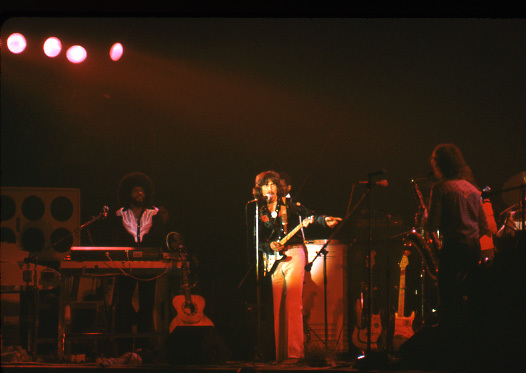

Harrison in Frail Voice - The Fuse Goes Out
By Philip Elwood
The San Francisco Examiner
November 7, 1974
It happens even to the best of Beatles. George Harrison's Cow Palace show last night was a fizzle, not a bomb, not an artistic catastrophe, rather more like a smoldering fuse of a potential earth-rocking electric music experience that sputtered along for a short time and then, with "My Sweet Lord", died out.
Never a strong singer but a moving one, Harrison found that he had virtually no voice left after only two concerts out of the 50 in the nationwide tour and had to croak his way through even the delicate "Something" and such fine numbers as John Lennon's "In My Life." With the strong jazz and blues rock tip behind him, Harrison's vocals usually went unheard when the amplification was turned up for Harrison's voice, and mixing problems developed. Indeed, there was never a time in the 80-minutes that Harrison and his band were on stage that the sound system was properly balanced. Harrison participated, one way or another, in 17 tunes, three of them specialties for organist vocalist Billy Preston and one instrumental featuring feature for reedman Tom Scott.
The evening's biggest roar from the approximately 13000 in the audience came for Preston, especially on "Nothing From Nothing," and "Let it Go Around in Circles." Harrison was cordial but nervous. He frequently alluded to "Me bad throat tonight" or said, "My voice's really shattered." After the latter, he performed "Give Me Love" later, saying quite apologetically, "We're not sure what you expect to hear, what you want us to play, but what we want to do most is make people happy."
The orchestra looked good and played marvelously. Preston, as an organist, singer, dancer, and charismatic focal point, was sparkling all evening. Backup guitarist with the solo here and there was Ukiah's own Robben Ford, exuberant as always, swinging and swaying, working one end of the center stage instrumental teeter-totter as whom fulcrum was. Harrison's drummer, Andy Newark, the steady, rich-toned bassist Willie Weeks, and percussionist Emile Richards played everything from vibes to chimes to bells and bongos. Scott was joined by the suburb Jim Horn, also on reeds, and Chuck Findley on brasses, on "Darkhorse." Findley also played flute, making it a three-man flute accompaniment for Harrison's wheezy vocal.
Besides the two mentioned, there were a couple of other Beatles, numbers "For You Blue" and "While My Guitar Gently Weeps," "What Is Life?" "Sound State of Mind" and "Sue You, Sue Me" were newer tunes included .
The Ravi Shankar family, a 15-member Indian instrumental and vocal ensemble, took over for 50 minutes of the program. Scott remained with Shankar playing flute, and others of Harrison's band played the first and last of the Indian music presentations, one called "The Dentist Song Zum Zum", and the other "Disputes and Violence", a jazz-style arrangement with solo inserts. Shankar led the ensemble much of the time, playing sitar only sparingly. What might have been a relaxing interlude of Indian music turned out, in the light of the lackluster Harrison rock presentation, to be a directionless sequence.
When the tour began, Harrison said, "As long as I'm into the motion, I may well cover as many places as I can." He had originally contemplated only eight or 10 shows, rather than 50. I hope he doesn't ultimately regret his decision.
Sunday, November 3, 2024
George Harrison: Weak and Feeble at Start of Tour

George Harrison Weak and Feeble at the Start of Tour
By Jeani Read
November 4, 1974
The Province (Vancouver, British Columbia)
It was George Harrison's concert, his first North American appearance since a concert for Bangladesh in 1971 and the debut of a seven week tour.
And for a long time, all I could think about was Dylan. Bob Dylan. A few months ago, making his first tour in what seemed like forever, singing all his songs wrong for the people who wanted to hear them the way they were used to hearing them. Harrison sang most of his songs wrong, too, except the painful difference, and it was painful, was that Dylan was in complete control of what he was doing. It was an extraordinary experience in image, breaking a personal integrity, if you will. And George, well, George didn't seem as if he knew what he was doing at all.
The double image kept reoccurring, reinforcing at first by the fact that when Harrison stepped up to the mic to sing, His voice sounded curiously broken and Dylanesque. Except Dylan has always sounded like that, and now he was pushing it, fighting and almost venomous, powerful and acidic, and George was weak and feeble.
Dylan, authoritative and uncompromising. Harrison, bobbing and smiling hopefully through gaunt cheeks. I'm back. Do you like me? Please?
Dylan surrounds himself with strong musicians, splitting the show with him and still incontestably dominant. Harrison does the same, but he is unable to dominate anything that happens and too often embarrassingly upstaged.
On Saturday, the evening started, hopefully enough, with George and the band delivering an almost southern Allman-style instrumental while his Dark Horse record label logo unfurled on a huge screen above the stage. Two Indian characters representing universality lit up the side curtains, anticipating the imminent arrival of Harrison's spiritual and showbiz companion, Ravi Shankar.
The previously silent, perhaps reverent, crowd packed into the Coliseum broke into a rewarding, sparkle, lit ovation, but the following three hours did little to inspire a similar response, rendering the audience, with rare exceptions, to a state of long suffering.
The band, three horns, drums, guitar, precussion, bass and Billy Preston on keyboards has impeachable track records. It featured such people as Tom Scott on sax and woodwinds, Andy Newmark on drums, Willie Weeks on bass, and Robben Ford on guitar. Their credits reach from Jimmy Dorsey and Buddy Rich to Sly Stone and Scott's own L.A. Express.
But the sound was poorly balanced and erratic, and the band, through the first four selections that included a number from Harrison's own Material World album and his Beatles legendary "Something" never galvanized into a satisfactory working unit. It was not until at least Billy Preston took over with a strutting version of "Will It Go Round in Circles." Here, the saxes, trumpets, and rhythm section felt considerably more at home. At last, something to hang some meaty horn lines onto, something to lean and dig into, which they did, and that's pretty well how it went.
George kept on singing his sweet, mild tunes off key, pathetically struggling through his edgy range, offering some nicer guitar licks, but rarely any head turning great ones. And Preston, who was out front and centered only twice more "Outta Space" and Nothing from Nothing", didn't even have to try to steal anything from the star. Just a couple of tightly punctuated organ hits, a shot or two, and it was stolen.
Even Georgia's best shots, "Sue Me, Sue You,"" While My Guitar Gently Weeps","Give Me Love" were received with nothing like the kind of enthusiasm that Preston's efforts earned. You couldn't even get away with calling it good pacing. And then there were, of course, Ravi Shankar and his dozen plus family who occupied 45 minutes in the middle of the show in what was not so much a cultural exchange as a cultural gap, very nice innovations, and shortcut ragas, compositions based on various Indian folk tunes, an orchestra of instruments and voices hypnotic, changing textures, flexible, impossible rhythms.
Shankar first conducting and then playing the audience polite and surprisingly receptive, but the twain never managed to meet, except perhaps in a later moment, when, with both contingents on stage at the same time, they delivered an intriguing mix called "Dispute and Violence". Otherwise, George said,"as jazz."
So after a night of musical raggedness, concerted physical leaps, and get it on soul training. Anti rock star Harrison closed with "My sweet Lord.", It is refreshing to find in a performance press biography, (although unfortunately fraught with suspicions of plastic virtue), that his personal ambitions now are to have no personal ambitions and that his professional ones are to do a worthwhile job and to leave it vaguely completed. But if you stick to that, you end up with a concert tap that feels even less than vaguely complete, And it is anything to pay $10 for.
Wednesday, January 31, 2024
The "Let it Be" concert


January 31, 1969
I know it isn't really a concert, but in my mind, the songs the Beatles played on January 31, 1969 at the Apple Studios was a like a concert. They could not play songs such as Let it Be on the rooftop, so they performed the rest of the songs in the studio. And what a performance they gave!!
Subscribe to:
Posts (Atom)